You've found a GSM spec sheet from your yoga apparel supplier. Every number looks the same — 200gsm, 220gsm, 250gsm — listed in a column that tells you almost nothing useful. Will your leggings survive a squat without going sheer? Will your sports bra feel like second skin or a soggy compress after hot yoga? Those numbers alone won't answer that.
That gap between what fabric weight means on paper and what it does on a body is where sourcing decisions fall apart.
What GSM means in fabric goes beyond a single number. Grams per square meter translate into opacity, compression, breathability, and drape — and each activewear category needs something different. Get that translation right, and you send out samples you're proud of. Get it wrong, and those samples disappear into a drawer.
This guide maps the numbers to real performance. You'll also find a decision matrix to use before placing your next order.
GSM Decoded: From Fabric Weight to Activewear Performance
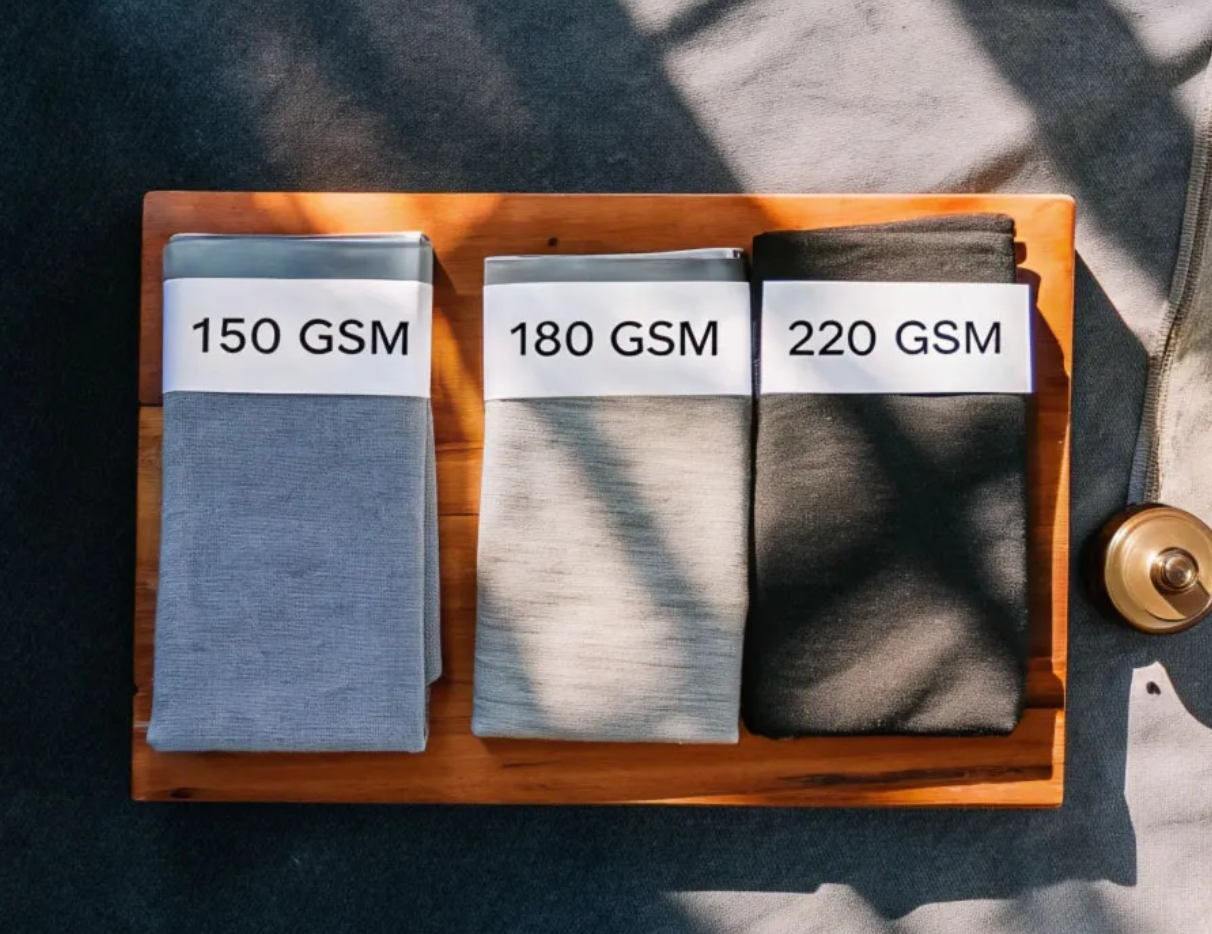
One square meter of fabric. One number. That number is supposed to tell you whether your leggings survive a deep squat — or go sheer under studio lights.
Here's how it works: GSM stands for grams per square meter. It measures how much fiber is packed into a standard 1m × 1m piece of fabric. Want to check a yoga apparel supplier's fabric GSM spec yourself? Cut a 10cm × 10cm swatch. Weigh it in grams. Multiply by 100. A swatch at 1.8g gives you 180 GSM. Simple math, with real consequences.
GSM is useful — and widely misread. What trips people up is what it does and doesn't control.
GSM influences:
- Opacity — more fiber per area blocks more light. This matters a lot for light-colored leggings that can't afford to go see-through
- Compression and structure — higher GSM fabrics hold their shape against the body. They don't drape away from it
- Thermal retention — denser fabric traps heat. That's a plus in winter tights. It's a problem in hot yoga
- Durability baseline — more fiber per square meter means more resistance to pilling and abrasion over time
- Cost — higher GSM uses more material. That cost lands in your price-per-meter
GSM does not control:
- Softness — that comes from fiber type and finishing
- Stretch percentage — that's spandex content and knit structure
- Moisture-wicking performance — that depends on fiber properties and technical finishes
This gap matters in sourcing. A 200 GSM fabric isn't softer, stretchier, or tougher than a 180 GSM fabric by default. It just holds more fiber mass per area. That extra mass can support certain performance traits — but only if the fiber is knit and finished the right way.
GSM is a starting point, not a finish line. Think of it as a chain: GSM → knit density → hand feel and structure → functional performance. Each link shapes what your finished activewear does on a real body. Ignore any one of them, and the number alone won't save you.
Product-Specific GSM Reference Ranges for Activewear
Each activewear category sits at a different point on the GSM scale. Those gaps matter more than most sourcing guides let on.
A leggings fabric and a yoga top fabric can share the same fiber content, the same spandex percentage, even the same yoga apparel supplier. Put 160 GSM into a legging, though, and you get something that works great as a lounge pant — and fails under studio lights. Put 260 GSM into a summer tank and you've built a garment nobody wants to wear past the warm-up. The numbers below aren't arbitrary. They show where real performance starts and where it breaks down — category by category.
Yoga Tops & Tanks
This is the lightest category in activewear. Breathability matters here more than anywhere else.
130–160 GSM — hot studio and summer tanks. Thin, airy, minimal structure. Polyester-spandex and nylon-spandex blends made for heat live here. You're not buying coverage — you're buying airflow. Standard "Dri-Fit style" athletic shirts sit in this band for a reason.
160–190 GSM — everyday training tees. The solid middle ground. Heavy enough to drape well and give decent opacity. Light enough to stay breathable through a full session. Most all-season gym tees fall here.
190–220 GSM — structured and oversized styles. At this weight, a top starts to feel more substantial. The hand feel gets more cotton-like. The drape gets fuller. Cooler-weather base layers, street-style training pieces, and premium oversized cuts all land in this range.
Leggings & Tights
GSM mistakes show up fast in this category. Sometimes you can see them — straight through the fabric.
160–190 GSM — ultra-light "second skin." Low opacity, high stretch, minimal compression. These suit lounge leggings, fashion tights, and yoga styles where drape is the priority. They are not squat-proof. Don't market them as such.
190–230 GSM — standard yoga and Pilates leggings. Soft hand feel, moderate coverage, comfortable through low-to-mid intensity movement. Nylon or polyester with 15–25% spandex fits well here. This is a comfort fabric, not a compression fabric.
230–260 GSM — squat-proof, sculpting, light compression. This is the most important band in the leggings category from a sales standpoint. The fiber density is high enough to block light and hold structure through a full range of motion. "Squat-proof" claims belong here. So do performance and shaping claims.
260–320 GSM — high compression and winter tights. Dense, warm, and structured. Cold-weather running tights, "sculpt and lift" collections, and high-compression training bottoms all operate here. Go above 300 GSM and you get serious thermal retention — great in winter, brutal in a heated studio.
Sports Bras
Sports bras are more complex than a single GSM number can show. Most performance styles use two or more fabric layers. Each layer carries its own GSM, and each one matters on its own.
180–220 GSM outer — light yoga bras and bralettes. Single-layer construction, elastic underband, minimal compression. The same jerseys used for standard leggings and fitted tops work here when cut as bra shells. Good for low-impact movement and studio settings.
220–260 GSM outer + 120–180 GSM lining — medium-to-high support. The outer shell handles structure and opacity. The inner lining manages comfort and modesty. Double-knit or brushed interlock outer fabrics in this range, paired with a lighter mesh or brushed liner, give you the layered feel that mid-to-high support bras need. This combo hits the performance sweet spot for most structured sports bra styles.
260–300 GSM outer + 120–180 GSM power mesh — high-impact compression bras. At this weight, the outer shell is dense enough to control serious movement. Power mesh cradles and wing inserts — 120–180 GSM — add ventilation and targeted stretch control without bulk. High-impact running bras and HIIT-specific styles are built this way.
The Quick-Reference Matrix
Check this before placing your next fabric order:
Category | Use Case | Recommended GSM |
|---|---|---|
Yoga top / tank | Hot studio, summer training | 130–160 GSM |
Yoga top / tee | Everyday gym, all-season | 160–190 GSM |
Yoga top / tee | Structured, oversized, cooler weather | 190–220 GSM |
Leggings | Lounge, fashion tights, drape-focused | 160–190 GSM |
Leggings | Standard yoga, Pilates, low-impact | 190–230 GSM |
Leggings | Squat-proof, sculpting, light compression | 230–260 GSM |
Leggings / tights | High compression, winter, shaping | 260–320 GSM |
Sports bra | Light support, bralette, studio yoga | 180–220 GSM (outer) |
Sports bra | Medium–high support | 220–260 GSM outer + 120–180 GSM lining |
Sports bra | High-impact, compression, HIIT | 260–300 GSM outer + 120–180 GSM power mesh |
These ranges are built around real activewear production — not theoretical textile averages. Where your product lands within a range depends on fiber composition, knit structure, and finish. That cross-effect is the next piece of the puzzle.
How GSM Tiers Translate to Opacity, Compression & Breathability
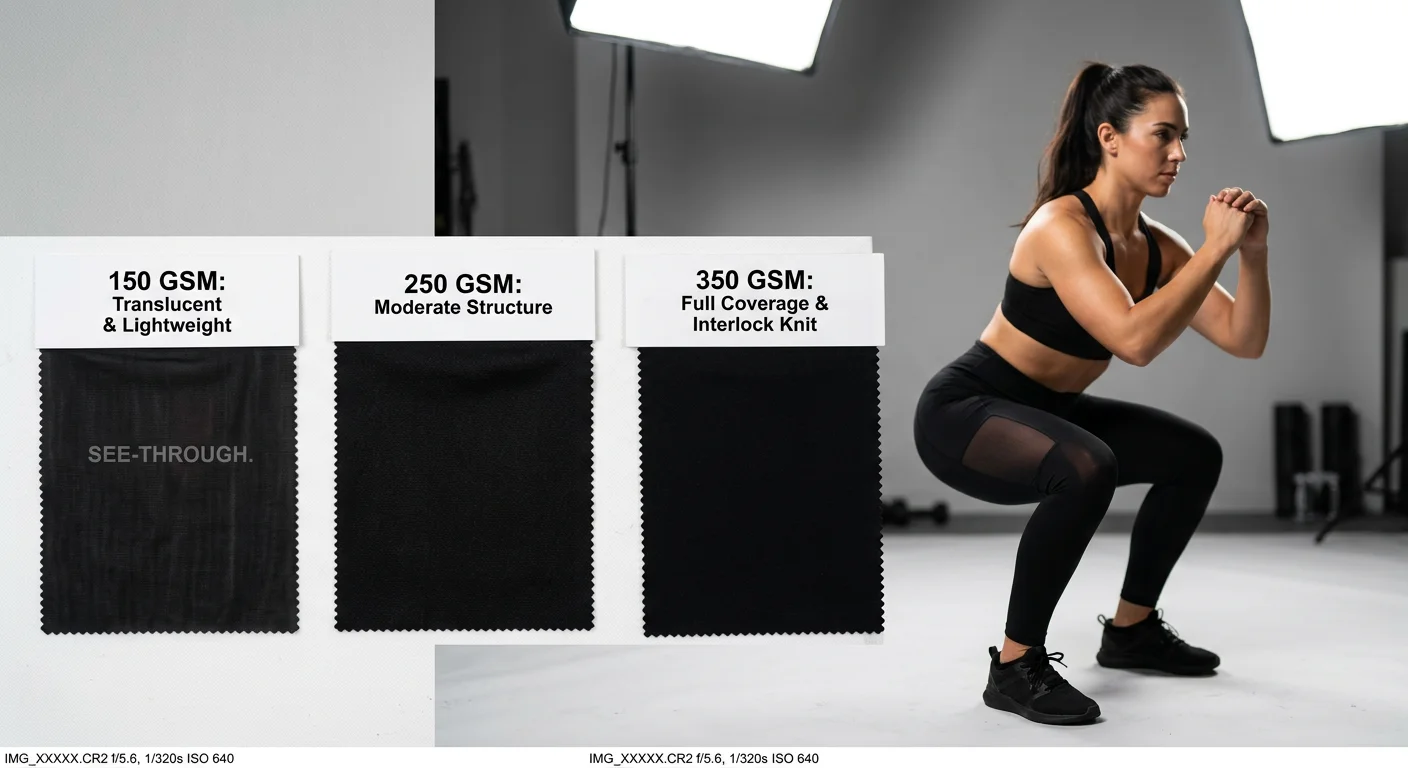
Three things kill an activewear sample faster than anything else: fabric that goes sheer in a squat, fabric that kills movement, and fabric that turns a workout into a sauna. All three trace back to GSM — and to which tier your fabric lands in.
The tiers below aren't marketing brackets. They're performance thresholds. Move from one to the next and something real changes — in how the fabric covers, holds, and breathes against a body in motion.
≤180 GSM — Light, Airy, and Honest About Its Limits
This is the tier where breathability peaks and opacity becomes a real concern. Maximum airflow makes it a strong choice for hot climates, humid studios, and loose-cut silhouettes where coverage isn't the goal. Bikram yoga, summer tanks, beachwear cover-ups — this is their natural home.
What it won't do: hold shape, conceal, or compress. The hand feel is soft and drapey — often described as "buttery" in brushed finishes — but there's minimal structure against the body. Light and pastel shades in this range carry the highest sheer-risk under stretch. A customer bends forward in bright studio lighting, and the fabric tells the truth.
Don't position ≤180 GSM leggings as squat-proof. They aren't.
190–220 GSM — The Studio Middle Ground
Opacity improves here, but it isn't guaranteed. Dark colors in this tier are safe as a rule. Light colors can still show texture or underwear lines under direct studio lighting or during deep stretches. This is a "manage the risk" zone — not a "risk eliminated" zone.
The feel shifts. There's a gentle all-day-hug quality — enough structure to feel supportive without restriction. Stretch recovery is better too. This tier suits AC-cooled studios, everyday training, and styles that need to go from gym to street without looking like compression gear.
Breathability stays balanced. You get airflow without feeling exposed. That's what most standard yoga and Pilates styles need.
220–260 GSM — Where Squat-Proof Claims Become Defensible
This is the most important commercial tier in activewear. The fiber density crosses a real threshold here: full coverage under strain, solid hold through the hips and tummy, and shape-recovery that lasts a full session — not just a fitting room try-on.
The opacity jump between sub-180 GSM and 220+ GSM is the sharpest improvement on the whole scale. Most mainstream squat-proof leggings sit in the 220–260 GSM band. That's no accident.
Breathability takes a modest step back. This tier runs a bit warmer — fine for temperate climates and cool studios, but worth flagging to customers shopping for hot-weather training. It's a fair trade when coverage and shaping are the priority.
The 220–260 GSM range is the performance sweet spot that shows up again and again in real production specs — and for good reason.
260–320 GSM — Compression, Warmth, and Full Coverage
At this weight, the fabric stops hinting at support and starts delivering it. The feel is firm, structured, almost armor-like — ideal for strong shaping, cold-weather running tights, and high-compression training bottoms where the garment is doing serious mechanical work.
Zero-transparency positioning is realistic here, with opaque knit constructions and deeper colorways. Coverage is full. The hold is firm enough to read as a true compression layer rather than a fitted fabric.
The tradeoff is warmth. This tier traps heat. In a non-air-conditioned studio or a humid summer climate, that becomes a problem fast. High-intensity, short-duration sessions in cooler environments are where 260–320 GSM earns its place. Extended hot yoga sessions are where it doesn't.
The Pattern Across All Four Tiers
Three clear relationships run through every GSM tier in activewear:
Opacity improves as GSM rises — the biggest single jump happens between 180 GSM and 220+ GSM
Compression increases with GSM — but fiber blend, knit density, and elastane percentage still shape the outcome. GSM alone doesn't make a compression fabric
Breathability decreases as GSM rises — lighter fabrics serve heat; heavier fabrics serve coverage and structure
One thing none of these tiers can tell you on their own: softness, stretch percentage, or moisture-wicking performance. Those come from fiber type, knit construction, and technical finishes — not weight alone. Sourcing decisions that stop at GSM always leave something out.
Fiber & Knit Architecture: Why Identical GSM Feels Different Across Materials
Two fabric swatches. Both 220 GSM. Both nylon-spandex. One feels like a second skin — smooth, firm, subtly compressive. The other feels loose and a little dead, like it's already given up before the first squat. Same number. Totally different garment.
This is the part of activewear sourcing that spec sheets don't explain.
GSM measures mass per area. That's it. It tells you how much fiber sits in each square meter — not how that fiber is arranged, what shape it's in, or how it behaves under tension. Once you grasp that distinction, you stop reading GSM as a performance guarantee. You start reading it as one variable inside a much more interesting equation.
Fiber Type: Why Nylon and Polyester Feel Different at the Same Weight
Nylon and polyester have different densities at the molecular level. Nylon 6 sits at 1.14 g/cm³. Polyester (PET) comes in at around 1.38 g/cm³. That gap changes everything about how a fabric feels at identical GSM.
Nylon is less dense, so its yarns take up more physical volume at the same weight. You get a fabric that feels fuller and more cushioned — one that holds its shape against the body with clear, strong resilience. At 220–240 GSM, a nylon-spandex blend with 20–25% spandex tends to be 10–15% more opaque and compressive than an equivalent polyester-spandex fabric at the same weight. That's not a small difference. In a squat, under studio lighting, that gap shows up fast.
Polyester at the same GSM behaves in ways that are genuinely useful — just for different applications:
Faster drying : polyester absorbs 0.4% moisture by weight; nylon absorbs closer to 4%. For team kit and high-sweat training, that gap matters
Better print clarity : polyester's surface chemistry makes it the go-to base for sublimation printing — sharper edges, more vivid color
Lighter drape : the fabric moves more freely, which suits relaxed cuts and looser silhouettes
The practical sourcing split looks like this:
Priority | Recommended Blend at ~220–240 GSM |
|---|---|
Premium yoga / sculpting compression | Nylon/spandex, ≥20% spandex, ≥40D elastane |
Teamwear / printed gym kit | Polyester/spandex, 10–20% spandex |
Hot-weather training, fast-dry | Polyester/spandex, moisture-wicking finish |
Designing for the "luxury yoga" market? Benchmarking against brands known for their "buttery, naked-feel" fabric? That feeling comes from nylon's smoother filament and higher yarn resilience — not from hitting a specific GSM number.
Knit Structure: The Architecture Behind the Number
Fiber type sets the foundation. Knit structure determines how that fiber performs under real movement. Two fabrics built from identical yarn can feel worlds apart depending on how the loops are formed.
Interlock (double knit) locks two layers of jersey together at the needle bed. This builds a fabric with stitches on both the face and back. At the same GSM as single jersey, interlock reads 20% thicker and more supportive — a solid industry rule of thumb with real production implications. A 220 GSM interlock nylon-spandex fabric can deliver the support feel of a 260 GSM single jersey in the same blend. So you engineer your way to perceived density without adding weight or cost. Sports bras and sculpting leggings benefit most from this.
Single jersey is lighter and more drapey at the same GSM. That's exactly what you want in a training top or a relaxed-fit lounge legging. Interlock holds. Single jersey moves. Both are useful. Neither is the universal winner.
Warp knit — tricot and raschel constructions — runs on a distinct principle. Yarns run lengthwise, with each needle carrying its own thread. The result: strong directional stability, less bagging at the knee and seat, better long-term shape recovery, and tighter compression per gram of material. At 200–220 GSM, a warp knit construction can match or beat the compression performance of a circular knit at 230–250 GSM in the same fiber ratio. For performance compression and shapewear collections, that matters far more than bumping up GSM.
The Spandex and Denier Variables
Knit type and fiber composition interact with two more variables that shape activewear material thickness and performance: spandex percentage and yarn denier.
High GSM + low spandex (below 12%) is a sourcing red flag. A 240–280 GSM fabric with just 8–10% spandex feels stiff and boardy. The knit structure carries the stretch load, but there's not enough elastic fiber to support real recovery. The fabric bags at the knees and seat after a few washes — heavy without being comfortable, covered without being compressive. You see this construction in lower-cost gym fabrics where high GSM signals quality without actually delivering it.
Mid GSM + high spandex (20–25%) + high denier yarn (75D or above) is the combination that beats heavier, lower-spandex alternatives. A 200–240 GSM nylon or polyester fabric with 20–25% spandex and 75D–100D main fiber delivers:
Strong four-way stretch with clean recovery
Reliable opacity through deep squats and lunges
A firm, "snappy" compression feel without the thermal burden of heavier fabrics
The rule-of-thumb formula for mid-range compression fabric GSM in performance leggings:
GSM : 200–240
Elastane : 20–25%
Main fiber denier : ≥75D
Knit : interlock or high-density warp knit
This combination consistently beats 230–260 GSM fabrics built with under 12% spandex — in both comfort and shape retention over time.
Here's the bottom line: GSM alone cannot tell you how a fabric performs. Two fabrics labeled "220 GSM nylon spandex" can feel totally different in your hands and behave differently on a body in motion. Fiber density, knit architecture, spandex percentage, and yarn denier all shape the outcome. They interact in ways that a single weight measurement was never built to capture.
Before placing a fabric order, ask your yoga apparel manufacturer for fiber composition, spandex percentage, yarn denier, and knit construction. GSM starts the conversation. Those four variables are where the real decision lives.
Sourcing Miscalculations: Real GSM Misfires & Their Business Costs
A wrong GSM spec doesn't announce itself as a sourcing error. It shows up later — in a return email from a buyer, a rejected shipment at QA, a markdown that eats your margin before the season ends.
The mill price looked fine. The landed cost did not.
The Hidden Cost Stack Behind a Single GSM Mistake
Every fabric order carries costs that never appear on the quote sheet. Think freight, duties, customs clearance, inspection, compliance testing, packaging adjustments, currency movement, and the internal hours your team spends managing the fallout. None of that lives in the per-meter price. A GSM misfire triggers returns or rework. Then all of it accelerates — fast.
Three GSM mistakes show up again and again in activewear production:
Leggings spec'd too light (≤190 GSM) and marketed as squat-proof. The unit price is attractive. The opacity isn't. Returns pile up. Customer trust drops. The cost of that "saving" spreads across freight, repacking, and replacement production. A heavier fabric at 230–260 GSM costs more per meter. It costs less overall.
Summer styles built on 260+ GSM fabric. The fabric passes every structural test. Your customer wears it once in July and puts it away for good. Slow-moving SKUs bring markdowns, clearance losses, and dead stock tying up warehouse cash. Inventory risk belongs in the sourcing decision — not the post-season debrief.
Fiber blend ignored at matching GSM. A 220 GSM polyester-spandex fabric and a 220 GSM nylon-spandex fabric share the same weight spec. Their performance outcomes are very different. Spec GSM without locking in fiber composition, spandex percentage, and knit construction, and a batch can pass mill testing and fail the fitting room.
What a Landed-Cost Model Catches That a Mill Quote Doesn't
Compare yoga apparel suppliers after adjusting EXW, FOB, and CIF quotes to a shared landed-cost basis. Add freight, duties by HS code, a quality-risk allowance for defects and rework, compliance costs, and management overhead. That's the number worth comparing — not the mill quote on its own.
Before bulk approval, run fit, opacity, stretch, pilling, and wash tests. Require GSM plus fiber blend, construction type, stretch and recovery percentages, and wash shrinkage limits. A spec sheet that stops at GSM has already left critical details out.
The procurement lesson is straightforward: measure total delivered cost plus risk cost plus inventory cost. The cheaper fabric is cheaper at the quote stage. After that, the math rebalances itself — at your expense.
The 30-Second Decision Matrix: Category × GSM Range × Target Scenario
Pull up your yoga apparel supplier's fabric menu. Five categories. One table. Thirty seconds to a solid spec.
Product Category | Target GSM | Recommended Fiber Blend | Optimal Use Scenario | Key Procurement Note |
|---|---|---|---|---|
Yoga Leggings (sculpt / squat-proof) | 230–260 | Nylon 75–80% / Spandex 20–25% | Studio to gym, HIIT, controlled temp | Specify interlock knit . Martindale pilling must hit ≥4–5/5 at 15,000 rubs |
Sports Bra (medium–high impact) | 220–260 (outer) + 120–150 (lining) | Polyester 80% / Spandex 20% | Running, cross-training, box jumps | Pair with power mesh lining . Test lateral stretch recovery — residual growth ≤5% |
Sports Bra (low support / lounge) | 180–220 (outer) | Recycled nylon 75–85% / Elastane 15–25% | Recovery yoga, light Pilates, all-day wear | Works best with seamless construction . Soft hand feel is the top priority |
Yoga Tops / Tanks | 140–180 | Poly or nylon blend; or cotton 90–95% + spandex | Low-intensity flow, barre, casual wear | Spec 4-way stretch . Lock in <4% shrinkage after three wash cycles |
Standard Training Tees | 160–190 | Polyester 90–95% / Spandex 5–10% | General gym, cardio, outdoor runs | Best GSM window for full-panel sublimation printing : 160–180 |
Three things to add to every spec before you send it back to your mill:
Fiber blend and spandex percentage — GSM alone is an incomplete instruction. The blend tells the full story.
Knit construction type — interlock, single jersey, warp knit, and seamless circular each perform in their own way at the same GSM. The number means little without this.
At least two functional test thresholds — pick from opacity under stretch, pilling resistance, or stretch recovery based on the product category.
The matrix gives you the starting point. Blend and construction are what turn those numbers into a real garment — not just a weight on a spec sheet.
Conclusion
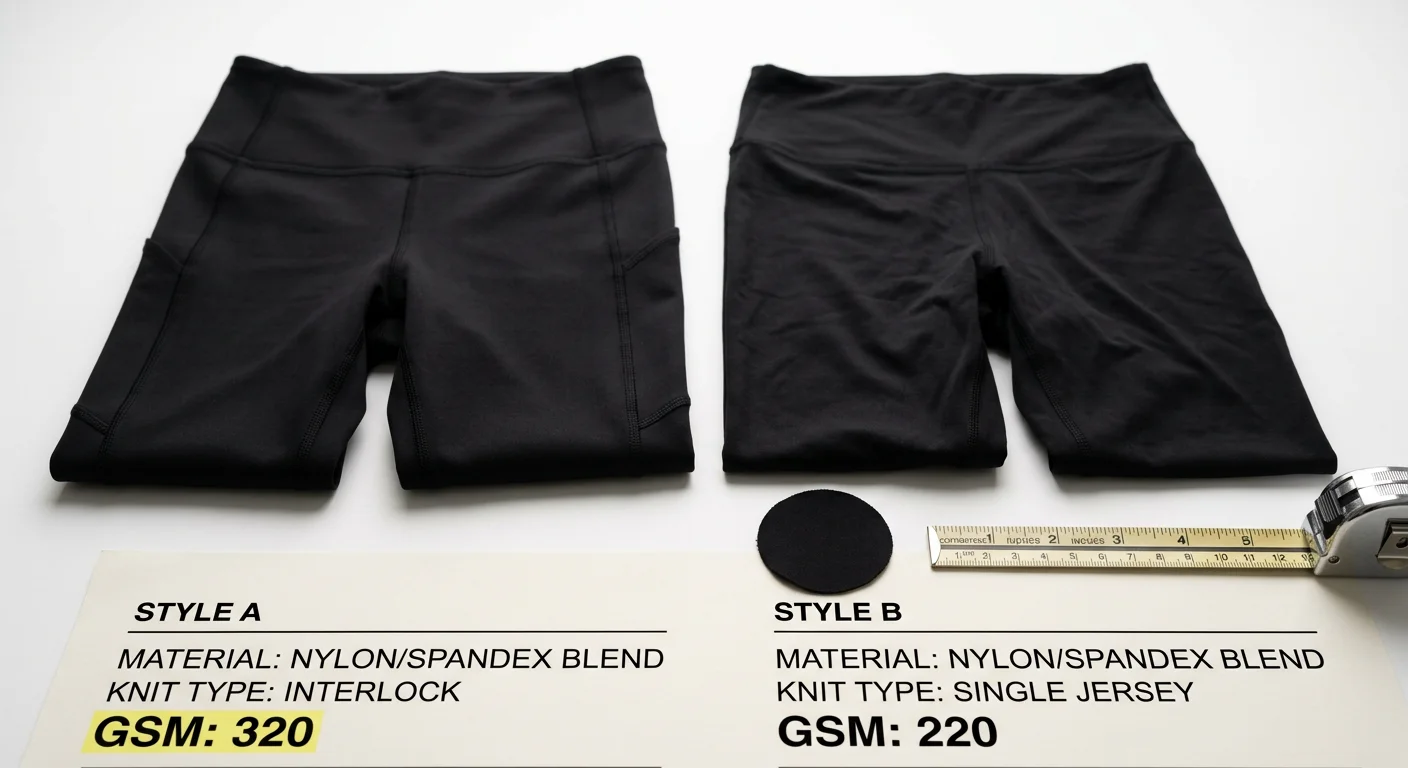
GSM is never just a number on a spec sheet. It's the difference between leggings that hold up through a squat and leggings that fail you.
At this point, you have what you need to stop guessing and start choosing with confidence:
Category-matched GSM ranges for different activewear types
Fiber interaction rules that explain why two fabrics at the same weight can feel completely different
Real sourcing examples that show how a 30-gsm miscalculation can damage your product line
The activewear material thickness sweet spot isn't found by copying competitors. It's not found by defaulting to whatever your yoga clothing supplier suggests, either. You find it by working backwards — from the body, the movement, and the exact moment your customer is getting dressed.
So before your next sampling round, pull up the decision matrix. Lock in your category, your scene, and your fiber blend. Then let GSM do the work.
The best activewear doesn't just fit. It performs — wash after wash, squat after squat, with zero doubt.