Finding a reliable activewear manufacturer in Asia is harder than it should be. For most Australian yoga brand founders, it feels like a minefield. You've browsed the Alibaba listings. Maybe you placed a sample order or two. Then the bulk shipment arrived — and it looked nothing like the photos. Trust disappeared fast.
The real problem isn't a lack of factories. Most sourcing advice ignores what makes australian yoga brand sourcing different. You're dealing with tighter MOQs. You need hard sustainability credentials like OEKO-TEX — not optional extras. Your fabrics have to perform through a Bondi Beach sunrise session and hold up under your customer's sharp Instagram review.
Generic advice doesn't cut it here. This step-by-step framework is built around the compliance requirements, aesthetic standards, and supply chain realities that Australian activewear brands face today. It's what works.
Defining Australian Brand Requirements & Compliance Benchmarks

Send that first inquiry to an Asian factory only after you know what you're asking for — and what Australian law requires you to deliver.
This isn't bureaucratic box-ticking. Wrong compliance benchmarks mean unsellable stock, ACCC enforcement risk, or worse: a product recall that burns your brand before it gains any ground.
What Australian Law Requires on Your Garments
The Australian Consumer Law (ACL) sets hard minimum standards for any activewear imported and sold in Australia. Three requirements are mandatory for yoga apparel before a single unit reaches your 3PL shelf:
Fibre content labelling : Every garment needs a permanent label. It must state each fibre by generic name and percentage by mass — "80% Nylon, 20% Elastane," not vague shorthand.
Care labelling : A durable label in AS/NZS format is required. It must cover wash temperature, drying method, ironing, bleaching, and dry-cleaning guidance. No exceptions.
Country of origin : The label must be clear and direct — "Made in Vietnam" or "Designed in Australia, Made in China." Labelling a product "Australian Made" while manufacturing offshore is an ACL violation. The ACCC treats misleading conduct as a serious offence.
Build these labels into your tech pack from day one. Adding them as an afterthought after bulk production creates real problems.
Chemical Safety: The Standard That Matters Most
Australia has no domestic equivalent of EU REACH. The practical benchmark your manufacturing partners must hit is OEKO-TEX® Standard 100 — it restricts harmful substances in dyes, finishes, and fabric treatments. For brands targeting health-conscious Australian consumers, this is the floor, not the ceiling.
Recycled fabrics are now the default choice for sustainable yoga apparel production. Demand OEKO-TEX certification documents from your fabric mill directly — not just from your cut-and-sew yoga apparel factory. Mills often subcontract dyeing to third parties. That's where chemical compliance breaks down most often.
Performance Benchmarks Your Factory Must Match
Australian yoga consumers are unforgiving. Instagram makes every flaw permanent. Put these specifications into every supplier brief:
Spec | Benchmark |
|---|---|
Fabric GSM (leggings) | 200–240 gsm, ±5% tolerance |
Preferred blends | 80% Nylon/20% Spandex or 85% Recycled Polyester/15% Spandex |
Squat-proof standard | 4/4 on internal opacity scale under full studio lighting |
Seam construction | 4-needle 6-thread flatlock (body), 3-needle coverstitch (hems) |
Your Production Calendar Has Built-In Compliance Deadlines
Most low MOQ yoga clothing suppliers won't tell you this upfront: compliance documentation takes time. It runs parallel to production — not after it.
Planning an Australian summer launch in January? Your backwards production plan looks like this:
August–October : Finalise designs, tech packs, and compliance label specs
Production window : 60–75 days for activewear (standard activewear production lead time )
Sea freight to Sydney/Brisbane : ~15 days port-to-port, plus a customs clearance buffer
Miss the label-printing window during production and two bad options remain: relabelling in a bonded warehouse at high cost, or pushing back your launch date. Neither works well for an emerging Australian fitness apparel brand chasing a seasonal window.
Green light signal : A factory that asks for your compliance label specs before sampling starts knows how professional activewear production works.
Red flag : Any factory that says labels can be "sorted later" — or offers to handle labelling without reviewing your specs first.
Regional Manufacturing Comparison: China, Vietnam, Indonesia & Bali
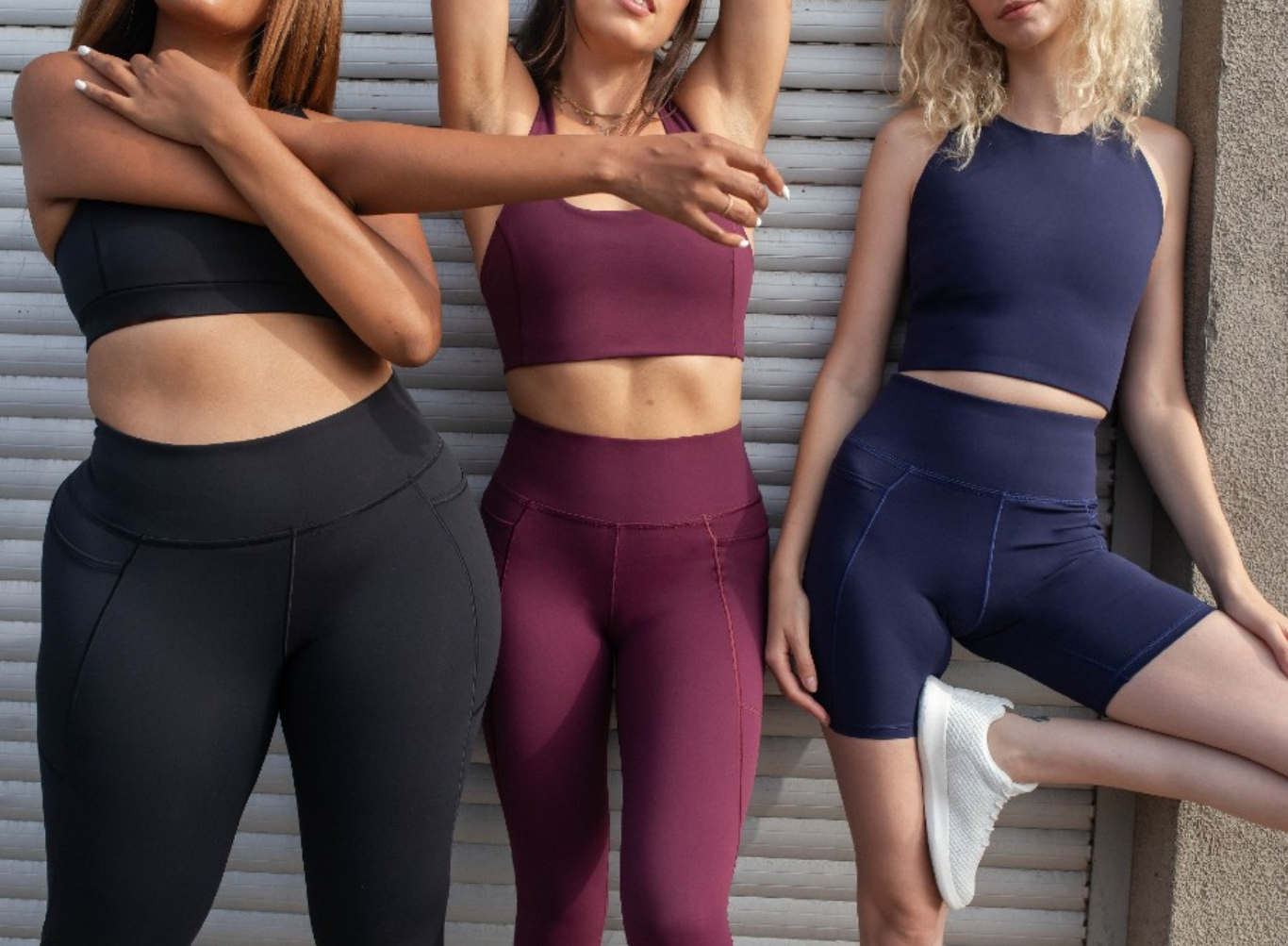
Four countries lead activewear sourcing for Australian brands. Each one solves a different problem — and brings different risks.
Here's the data that matters for your decision.
The Comparison at a Glance
Sourcing Hub | Typical MOQ | FOB Range (USD/pc) | Bulk Lead Time | Core Strength | Sustainability Level |
|---|---|---|---|---|---|
China (Guangdong/Zhejiang) | 200–500 pcs | $5–12 | 60–90 days | Full OEM/ODM, custom print, seamless, advanced tech | Medium–High (OEKO-TEX, GRS common; verify per factory) |
Vietnam (HCMC/Hanoi) | 300–1,000 pcs | $6–10 | 70–90 days | Technical sportswear, consistent QC, ethical compliance | High baseline (WRAP, GOTS, GRS at larger plants) |
Indonesia (Jakarta/Cikarang) | 500–3,000 pcs | $6–9 | 60–80 days | Mid-tier basics, bulk private label | Uneven — verify BSCI/SMETA factory by factory |
Bali (boutique studios) | 50–300 pcs | $11–18+ | 45–75 days | Small runs, yoga/swimwear, fast prototyping | Transparent practices; formal third-party certs less common |
What Each Market Means for Your Brand
China is the most fully connected supply chain option. Yarn, fabric, trims, printing, and logistics all sit within one region. Need a low MOQ yoga clothing supplier ? Smaller OEM yoga apparel studios in Guangdong can go down to 100 pieces per style. The FOB cost runs higher at that scale, but it stays workable for early-stage Australian fitness apparel brands. The tradeoff: social compliance (BSCI, SMETA) won't come standard. You need to request it, then verify it yourself. Don't assume it's already in place.
Vietnam holds the strongest credentials for ethical activewear manufacturing . The EVFTA trade deal and supply programs from brands like Nike and Lululemon have raised compliance standards well above most Chinese SME factories. The catch — most export factories set a minimum of 1,000+ pieces per style. Starting with 200-unit test runs? This market is not the right fit yet.
Indonesia's Java industrial belt works well for bulk basics. Simple active tops, fleece joggers, uniform-style garments — that's its sweet spot. High-end yoga legging manufacturer output exists, but that side of the market is still catching up. Port delays and slow internal communication are real risks to your production schedule. Factor those in before committing.
Bali is the outlier that catches most founders off guard. FOB prices sit at $11–18+ per piece — higher than China on paper. But it makes sense for a brand testing its first capsule collection. The 50-piece MOQ is accessible. Sampling runs 1–3 weeks. Studios tend to be Western-managed with hands-on support. That mix often justifies the higher cost. Plus, fabric sourcing for yoga brands in Bali moves fast — many conversations start on WhatsApp and land in a studio tour within days.
The Fast Filter for Australian Brands
Pre-revenue or first collection (under 300 units) : Start in Bali or China's small OEM studios
Scaling with sustainability requirements : Vietnam is your strongest long-term play for sustainable yoga apparel production
Bulk basics at competitive margins : Indonesia's Java belt, with thorough factory vetting
Custom technical fabrics of yoga apparel, seamless, or complex construction : China's Guangdong ecosystem has no real competitor
Sourcing Channel Mapping & Initial Filtering
Most Australian brand founders spend weeks browsing Alibaba. They fire off inquiries to 30 factories and hear back from 28 — none of which are a good fit. The problem isn't access to suppliers. It's knowing where to look first and how to cut the noise fast.
Where to Find Factories Worth Talking To
Four channels reliably surface qualified OEM activewear factory Asia candidates for Australian brands:
Alibaba.com is still the default starting point — but only if you filter hard. Use this search syntax to surface serious candidates straight away:
"yoga wear manufacturer" "low MOQ" "OEKO-TEX""activewear factory" "private label" "trade assurance"
Filter by: Verified Supplier + Trade Assurance + ≥3 years on platform + in-house manufacturer tag. Drop anything outside those parameters.
Global Sources leans toward larger export-focused factories with trade-show track records. There's less noise than Alibaba, but the average MOQ runs higher. Check it once your volume requirements are clearer.
Trade shows get overlooked by most founders doing australian yoga brand sourcing for the first time. Canton Fair Phase III (Guangzhou, October) is the most useful for side-by-side yoga apaprel factory comparisons. The Global Sourcing Expo in Sydney and Melbourne is worth your time too — exhibitors already understand Australian market expectations and smaller MOQ requirements. That saves you a lot of back-and-forth.
Sourcing agents make sense for your first order, orders covering fewer than three styles, or situations with heavy compliance obligations. Expect to pay an 8–12% margin premium. For most first-time buyers, that premium cuts more risk than it adds in cost.
Once you're running repeat orders with solid tech packs and internal QC in place, go direct. You get a lower landed cost, more control over activewear production lead time , and faster iteration on fabric and fit.
The 3-of-4 Rule for First-Pass Filtering
Before you share a single tech pack, run every supplier through this gate. Move forward with factories that hit at least three of these four:
Factory owns its cutting and sewing lines — confirmed via live video walkthrough, not just a photo gallery
Export experience of three or more years — not just "we work with international clients"
MOQ fits your current launch plan — not their ideal minimum, yours
Compliance evidence available — OEKO-TEX, GOTS, BSCI, or SMETA documentation on request
A supplier that clears three out of four is worth a sample conversation. One that clears two or fewer comes off the list.
Green light : The factory assigns a dedicated merchandiser within 24 hours of your first inquiry and replies the same day. That kind of responsiveness carries through bulk production too. It's a solid signal of how communication will run long-term.
Red flag : The factory hesitates or refuses to sign an NDA before you share design files. For any sportswear private label supplier relationship, IP protection is not up for negotiation. It's a baseline requirement — full stop.
The 5-Dimension Factory Evaluation Framework for Australian Yoga Brands
Most sourcing mistakes don't happen because founders chose the wrong country. They happen because the evaluation process stopped at price and MOQ. Picture this: a factory quotes $8.50 per legging and accepts 100 units. Sounds perfect. Then the bulk shipment arrives in the wrong colour, the seams pop at the hip, and your launch window is gone.
Five specific dimensions separate factories worth trusting from the ones that cost you a season. Evaluate every potential OEM activewear factory Asia candidate against all five before you share a single tech pack.
Dimension 1: Fabric Capability & Supply Chain Depth
This is where most evaluations go shallow — and where the real risk hides.
Top-tier yoga legging manufacturers run in-house knitting and dyeing for 30–70% of their core fabrics. That's not optional. In-house dyeing cuts lead time from lab-dip approval to bulk fabric by up to 12 days compared to outsourced mills. On a tight activewear production lead time , that gap is significant.
What to ask for:
- A fabric swatch kit: minimum 10–15 qualities, each labelled with GSM, composition, stretch percentage, and MOQ per colour
- Proof of supply relationships with GRS-certified recycled yarn vendors (scope certificates listing the mill)
- Colour matching data: lab-dip turnaround of ≤5 working days, with spectrophotometer reports showing Pantone TCX ΔE ≤1.5
Scoring it:
- ✅ Strong : In-house knitting and dyeing, at least two external mills for specialty fabrics, GRS or OEKO-TEX documentation available on request
- ⚠️ Acceptable : Cutting and sewing in-house, stable mill relationships, certifications available but slower to produce
- 🚩 Walk away : Swatches arrive unlabelled. Certificates show company names that don't match the factory. No spectrophotometer — just "visual colour check"
For fabric sourcing for yoga brands , the minimum you can't drop below is access to 80% Nylon 6.6 / 20% elastane or 85% RPET / 15% spandex at 220–260 gsm with GRS chain-of-custody documentation. No supply on that spec? Nothing else matters.
Dimension 2: Small-Order Flexibility & Pricing Transparency
Good factories accept 50–150 pieces per colour per style for startups. Most don't advertise this. You have to ask — and verify it in writing.
Here are the real price ranges for low MOQ yoga clothing suppliers producing recycled poly compressive leggings (FOB China/Vietnam):
Quantity | Estimated FOB Price |
|---|---|
100 pcs | ~US$11–13 |
300 pcs | ~US$9–10.50 |
500 pcs | ~US$8.50–9.50 |
1,000 pcs | ~US$7.80–8.70 |
Sports bras run lower — around US$7–8.50 at 100 units, dropping to US$5.10–5.80 at 1,000. Expect a 10–25% price surcharge below 300 pieces, or a flat small-order fee of US$100–300 per PO.
What to request before sampling:
Get a written, tiered price ladder covering 1 legging, 1 bra, and 1 top at 100 / 300 / 500 / 1,000 pieces — two colours each. Sample fees, pattern-making, grading, and print setup costs must be listed as separate line items. No bundled totals.
Scoring it:
- ✅ Strong : Accepts 50–100 pcs/colour/style, provides written price ladder, transparent fee breakdown
- ⚠️ Acceptable : MOQ 200–300 pcs, clear pricing, will discuss reduction on repeat orders
- 🚩 Walk away : "Discuss later" on pricing. No tiered sheet. Minimum 500 units per colour with all-in pricing and no breakdown
There's a negotiation move most buyers skip: ask about their repeat-order MOQ policy. Many solid factories drop minimum quantities by 30–50% once you reorder the same fabric and colour. Get that clause locked into your first agreement before you sign anything.
Dimension 3: Sustainability Certification & Chemical Compliance
Australian consumers are no longer forgiving on this point. "Eco-friendly" in marketing copy without third-party documentation is a liability — not a selling point.
For sustainable yoga apparel production , here's the certification hierarchy you need to check:
GRS (Global Recycled Standard) : Required for any RPET fabric claim. Ask for both scope certificates and transaction certificates from a previous RPET yoga order. Check that the company name and product category on the TC match the proposed production.
GOTS : Relevant if your collection includes organic cotton loungewear or activewear crossover pieces.
OEKO-TEX Standard 100 : The chemical safety baseline for all ethical activewear manufacturing . This covers fabric mills — their dyeing subcontractors included.
BSCI / SMETA / WRAP : Social compliance audits must be no older than 18 months. Request the full PDF, not a summary. Scan the QR code and verify it against the issuer's platform yourself.
Verification action : Ask for CAP (Corrective Action Plan) closure evidence on past audit findings. Before-and-after photos, updated procedures, and training logs reveal far more than a clean audit report ever will.
🚩 Immediate red flag : Self-declaration with no third-party audit. Certificates that don't match company names or product categories on cross-check.
Dimension 4: Technical Pattern Capability & IP Protection
A sportswear private label supplier that can't produce accurate Australian sizing will burn through sample rounds and delays. Your development budget takes the hit.
Acceptable tolerances for yoga legging samples:
- Waist: ±1.0–1.5 cm
- Hip: ±1.5–2.0 cm
- Inseam: ±0.7–1.0 cm
Here's a test that separates real technical factories from cut-and-copy operations : Send a tech pack for one legging and one bra with AU 6–14 gradation. A qualified yoga apparel factory returns a completed measurement chart with a development sample within 7–10 business days. They respond to tech pack questions within 24 hours. Updated graded specs come back within 2–3 business days.
IP protection is non-negotiable — same as pattern accuracy. Ask these questions outright:
- Who sees your designs inside the factory?
- Where are samples stored?
- Do they upload client samples to Alibaba or Instagram catalogues by default?
Scoring it:
- ✅ Strong : In-house pattern team, written no-showcase clause, separate client pattern archives, can demonstrate gusset construction and bonded seam experience
- 🚩 Walk away : They ask you to send finished samples to copy. Client designs appear in their public catalogue without permission.
Dimension 5: Australian Market Literacy
Generic sourcing guides skip this dimension. That's a mistake.
A factory with no experience producing for Australian brands needs educating on ACL labelling requirements, AS/NZS care symbol formats, and Australian sizing conventions. That education runs on your timeline and your budget. A factory that already knows these standards saves you two or three sample rounds straight away.
What to ask in your first call:
- Have you produced for Australian brands before? Can you share one reference?
- Are you familiar with AS/NZS care labelling requirements?
- What AU size range do you carry on your existing block patterns?
A factory that can discuss Australian fitness apparel sizing and compliance without needing a full briefing is one that operates on your level from day one. That shared understanding shows up in sampling speed, bulk accuracy, and smoother communication across every stage that follows.
Putting the Framework to Work
Score each factory candidate across all five dimensions before you put money into samples. A factory that scores high on price but fails on certification and IP protection is not a bargain. It's a problem waiting to land. The right activewear quality control Asia partner scores at least 3/5 across every dimension, with no single dimension sitting at 1.
That standard is what delivers consistent bulk production, credible sustainability claims, and a supply chain that holds up as your brand grows.
Tech Pack Execution & Sampling Validation Protocols
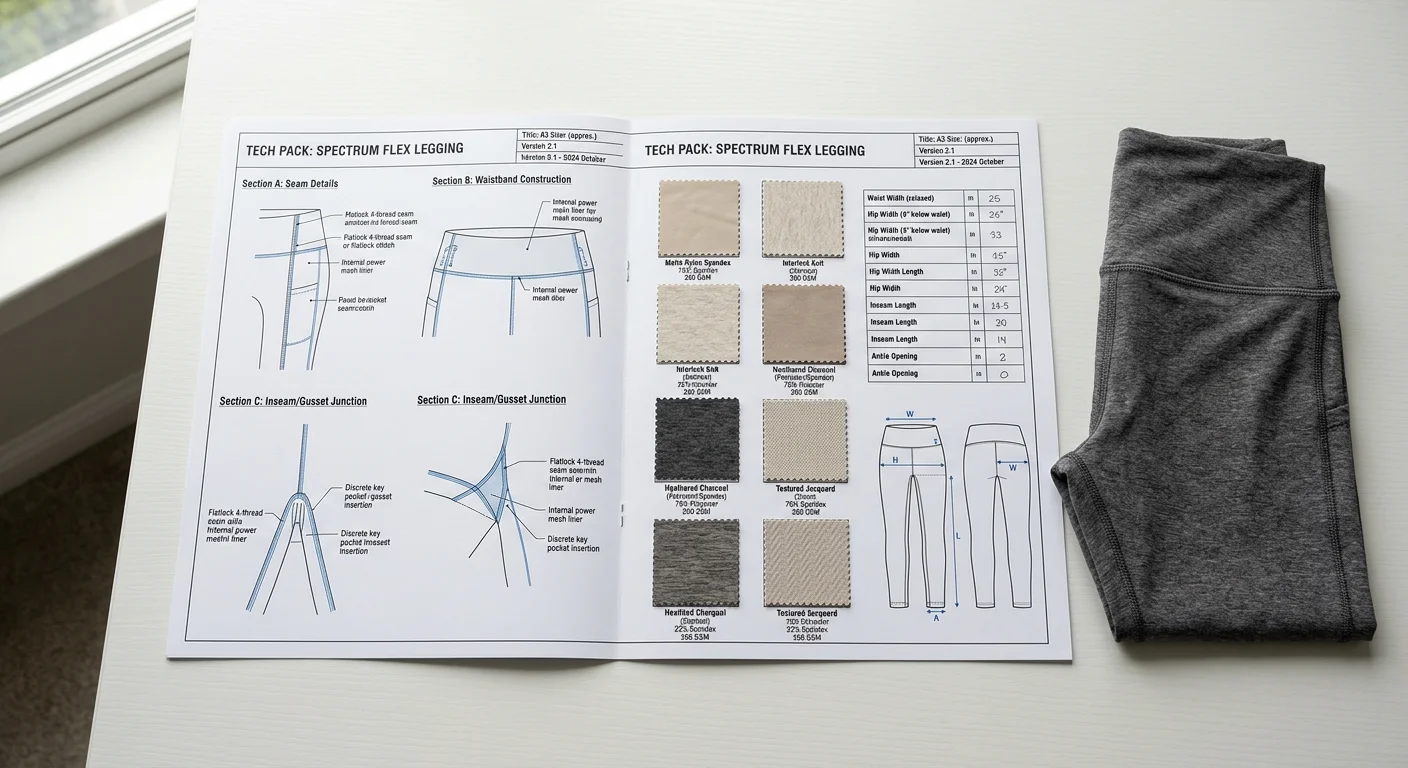
A bad tech pack doesn't just slow down sampling — it gives the factory permission to guess. Factories that guess produce garments that don't match your vision. They burn through your revision budget. They push your launch date back by weeks.
Build a Tech Pack That Eliminates Ambiguity
Your spec pack must cover every decision in writing before anything reaches the factory floor. That means CAD flats (front, back, close-up construction details), a graded spec sheet with full POMs and tolerance bands across your AU size run, and a complete BOM. The BOM should include fabric GSM and composition, stitch type, thread count, trim supplier references, and label placement.
Don't forget packaging specs. Folding method, polybag warning label, carton pack ratio, barcode placement — all of it belongs in the pack before the first sample is cut.
Review the pack in-house before you submit it. Check for missing measurements, conflicts between flats and written specs, and any construction detail a factory could read two different ways. Your team finds three problems during review? A factory will find twelve — and fix half of them without telling you.
The Five-Stage Sample Gate
Strong activewear quality control Asia runs through defined approval stages — not a single sample-and-approve shortcut:
Proto sample — confirms construction concept
Fit sample — validates block against AU sizing
Size set / SMS — checks grade consistency across XS–XL
PP / gold seal sample — pre-production sign-off reference
Bulk pre-production sample — final confirmation before cutting
Lock fabric lab dip and bulk swatch approval before sewing begins. Shade mismatch and hand-feel disputes are easy to avoid. Approve trim, thread, labels, and heat transfer samples as separate line items. Don't bundle them into one "sample approved" sign-off.
Measurement, Stitch & Wash — The Three Things You Test
Measurement match : Compare every critical POM against your graded spec sheet. Practical tolerance benchmarks for yoga legging manufacturer output: ±1.0 cm on core dimensions, ±1.5 cm on larger POM spans. Check left/right symmetry and front/back balance. Don't eyeball it.
Stitch integrity : Check for seam slippage, skipped stitches, puckering, and broken bartacks. For stretch goods — every sustainable yoga apparel production run qualifies — run a manual stretch-recovery check. Pull to 1.5× original length, hold 10 seconds, then release. No warp. No seam distortion. Anything less is a revision, not a pass.
Wash and colour performance : Run 3 wash cycles at 40°C before bulk sign-off. Inspect for colour bleed, shrinkage, seam torque, and pilling. The commercial benchmark for pilling is a Martindale appearance score of ≥4.0. For colorfastness to perspiration, reference ISO 105 C06. This is non-negotiable for activewear sold to Australian consumers who wear and wash these pieces on a regular basis.
Sample Fees & Revision Terms — Get It in Writing
Standard sample fees run USD $50–150 for basic styles, higher for technical constructions. Negotiate a 100% deduction of sample fees against your first bulk PO, with a minimum bulk threshold of USD $2,000 for full credit. The factory keeps requesting re-sampling? Define upfront whether revisions are included in one round, billed per revision, or credited to bulk. Leave it vague and it turns into a cost dispute.
Green and Red Signals During Sampling
🟢 Trust this factory : They ask specific questions about seam allowance, stitch class, and grade rules before cutting. They return a completed measurement chart within 48 hours. They send bulk fabric photos before sewing starts. They flag construction risks early, before those risks become problems.
🔴 Stop here : Unapproved construction changes appear in the sample with no explanation. Stitch descriptions read "normal stitch" rather than stitch class and SPI. The sample arrives after 30 days with no progress update. Measurement discrepancies get a "close enough" response instead of a revision plan.
Bulk production approval has one rule: every critical POM within tolerance, fabric and trim matching approved references, wash and recovery checks passed, and every deviation documented in writing — before a single bulk unit is cut.
Production Capacity Verification & Quality Control Setup
Here's a truth most Australian founders learn the hard way: a factory that quotes well and samples great can still destroy your launch. Not through bad intentions — through sheer inability to deliver your volume, on your timeline, at the quality level your customers expect. Capacity verification isn't optional. It's the difference between a brand that scales and one that fires its supplier after order two.
Verifying Real Production Capacity
The number a factory gives you on a call means almost nothing. What matters is the infrastructure behind it.
For activewear manufacturing in Asia, a stable, right-sized partner runs somewhere between 30,000–300,000 finished pieces per month across all buyers combined. Below that floor, the factory is too small to absorb your growth. Above that ceiling, you become a rounding error on their production board — and your order gets pushed aside the moment a bigger client calls.
Evaluating any OEM activewear factory Asia candidate? Ask these specific questions:
"What was your peak output in the last 12 months, by style and fabric type?"
"What's your average on-time delivery rate for export orders last year?"
The benchmark answer to look for: at least one completed run of >20,000 pieces of similar fabric complexity , delivered on time, with a >95% punctual shipment rate across annual export orders.
Then get specific on line structure. A serious yoga legging manufacturer running activewear at scale should show you:
Production Stage | What to Look For |
|---|---|
Cutting | 1+ automatic spreader, CNC or die cutter; 5,000–10,000 pcs/day per automatic line on knit |
Sewing | 8–24 lines, 18–30 machines each; 800–1,500 pcs/line/day depending on style complexity |
Finishing/Packing | 20–30% higher throughput than sewing to prevent bottlenecks |
For dedicated activewear lines, the minimum signal to look for is 2–4 lines set aside for high-stretch fabrics only — staffed by technicians who know performance seaming, not just woven garment construction. Per sewing line, check the machine mix:
4–6 coverstitches (hems, waistbands, cuffs)
2–4 flatlocks (flat seams on leggings and tops)
6–10 overlocks/5-thread (general assembly)
1 bartack per line (stress point reinforcement)
🟢 Green light : The factory provides a written line allocation plan for your specific PO — for example, 20,000 leggings across 3 sewing lines at 1,000 pcs/line/day, mapping out cutting (3 days), sewing (~7 days), finishing and packing (3–4 days), with buffer built in for rework and QC.
🚩 Walk away : The factory gives you a capacity number but can't break it down by line, stage, or style complexity. That's not a production operation — it's a sales pitch.
The Production Gantt Chart — Make It Contractual
Before a single metre of fabric gets cut, ask your supplier to submit a production Gantt chart covering every stage with dates and output targets per day:
Fabric and trims received in-house → lab-dip and bulk shade approval
Cutting window: spreading, cutting, bundling, numbering
Sewing: line feeding date, output ramp-up (60% → 80% → 100% efficiency)
Inline QC milestones: first-piece approval, first 200 pcs per line checked, routine checkpoints every 30 pcs
Finishing: thread trimming, ironing, measurement check, ticketing
Final inspection: in-house AQL plus external if applicable
Packing and container loading: carton sealing, palletizing, FCR date
Attach this Gantt as a contractual annex . Link payment or shipment approval to hitting these milestones. A factory that won't put dates on paper won't hit them.
Inline QC — The Standard for High-Stretch Activewear
Generic QC frameworks don't work for yoga apparel. The fabric behaves in its own way. The failure modes are different. Activewear quality control Asia needs specific checkpoints built for high-stretch construction.
Agree these inline standards in writing before bulk starts:
Sampling frequency : minimum 1 piece per bundle, or every 30 pieces per operation per line — whichever is higher.
Seam tension test : stretch to 120–130% of garment width . No seam cracking, no popped stitches, no broken threads.
Seam puckering : visual grade ≤ Grade 3 on a 5-point scale (5 = no puckering) on flat seams and hems.
Stitch density : 8–12 SPI (stitches per inch) on knit activewear, tolerance ±1 SPI.
Inline measurement checks : every size, every colour, at least 1 piece every 2–3 hours per line, measured against your graded spec sheet. Main body tolerances: ±1.0 cm. Critical measurements (waist, inseam): ±0.5 cm.
Defect trigger : any checkpoint that logs a defect rate above 2–3% stops the line. Root-cause analysis runs before production picks back up. Write this clause into your supplier agreement — don't assume it's standard.
Final Inspection — AQL Levels That Protect Australian Brands
Set your AQL levels in the contract before production begins:
Major defects : AQL 2.5
Minor defects : AQL 4.0
Critical defects : AQL 0 or 0.65 (sharp points, contamination, severe staining, wrong size ratio — zero tolerance)
Use ANSI/ASQ Z1.4 (ISO 2859-1) normal inspection, single sampling plan. For a 5,000-piece order at Level II, that means a 200-piece sample , with acceptance at around 10–14 major defects depending on the table. Define your exact acceptance numbers in your QC spec before the factory prints a packing list.
Activewear-specific final inspection tests that matter:
Stretch and recovery : manual pull to 120% for 10 seconds — check recovery and bagging after release
Colorfastness rub (dry and wet) on all dark colourways
Opacity/transparency check in squat and bend positions under studio lighting
Wash test : minimum 1 garment per colour and size washed once at 40°C — target shrinkage <3–5% , print durability confirmed
Third-Party Inspection — When It's Non-Negotiable
For Australian yoga brand sourcing , budget for third-party inspection on your first two to three orders from any new yoga apparel supplier. Do the same for any order exceeding 1,000 pieces of technical product.
Providers worth using: SGS, Bureau Veritas, Intertek, TUV . Standard rates in major Asian hubs run US$150–250 per inspector-day , excluding travel surcharges for remote facilities.
Build this clause into your supplier agreement:
"Shipment is conditional on a PASS report at agreed AQL 2.5/4.0, issued by buyer-nominated agency. Supplier agrees to cooperate with unaccompanied inspector, provide sample room access, full packing list, and open cartons on request."
A factory that pushes back on an unaccompanied inspector is telling you something important about what they don't want you to see.
🟢 Trust this factory : They share a written AQL procedure with defect categories and sampling plans. They send inline QC photos and short video clips from the cutting room and sewing floor at least once or twice per week during bulk. They accept a third-party inspection clause without pushback and can produce recent fire safety certificates, evacuation drill records, and a machinery maintenance log on request.
🚩 Stop here : No written QC procedure exists — "we check everything carefully" is the answer. The factory declines an unaccompanied inspector or asks you to "arrange in advance." No line allocation plan for your specific PO. Capacity claims are round numbers with no breakdown by stage or style.
The factories worth building long-term activewear production partnerships with treat your scrutiny as a sign of professionalism — not an inconvenience. That attitude shows up in sampling. It carries through to bulk. And it's what keeps your activewear production lead time predictable season after season.
First-Order Negotiation Tactics & Manufacturing Agreement Clauses
Most Australian founders lose money in the contract conversation — or worse, sign terms that hand all the leverage to the factory.
A solid first-order agreement isn't about being difficult. It's about building accountability into the relationship before problems show up. Here's how to do it.
Payment Structure: Tie Every Milestone to Performance
Drop the standard 30% deposit, 70% on shipment model. That structure pays the factory for shipping — not for shipping right .
For first orders under USD $50,000 (FOB basis), push for this instead:
30% deposit — paid within 5 business days after pre-production (PP) sample approval, not on order placement
40% payment — released after a passed inline inspection report (when 20–30% of bulk is completed)
30% final — against a clean onboard bill of lading plus a confirmed final inspection pass
The factory gets full payment only after quality is checked at two separate points. For orders over USD $10,000–20,000, look at an irrevocable LC at sight . It gives the factory bankable security. You don't release funds until shipping documents and inspection reports are in hand.
One tactical move worth using : offer a higher deposit — 30% instead of the factory's preferred 20%. In return, ask for two things — no payment due at order placement, and a fixed unit price locked for this PO plus your next reorder within 90 days. Most factories will take that deal. You give them earlier cash flow certainty. They give you price stability.
Delay & Quality Penalties: Build the Clause Before You Need It
For Australian yoga brand sourcing , seasonal launch windows are fixed. A delay penalty clause isn't aggressive — it's basic supply chain risk management.
Delay penalty model to negotiate:
Days Late | Consequence |
|---|---|
1–7 days | Grace period — no penalty |
8–14 days | Factory covers 50% of air freight differential to meet delivery date |
>14 days | Right to cancel unshipped balance + full air freight differential covered by factory |
Cap the total penalty at 10–15% of PO value . This keeps the clause enforceable in court without pushing too far.
For activewear quality control Asia , pair this with a clear AQL quality remedy clause:
"If the defect rate in any inspected lot exceeds AQL 2.5 (Major) or AQL 4.0 (Minor), Manufacturer shall — at Buyer's election — rework or replace non-conforming units at a 1:1 ratio within 15 days at Manufacturer's cost, or provide a pro-rated refund for affected units within the same period."
Add one more clause most brands skip: rejected units bearing your trademark cannot be sold, diverted, or disposed of without your written consent. This is critical for sportswear private label supplier relationships where your brand sits on every label.
Sample Costs & Tooling Ownership: Get Your IP on Paper
Pattern files, grading sheets, and tech packs created for your brand belong to your brand — not the factory. Put this in writing, clearly, in the agreement.
On sample cost recovery, negotiate this standard:
"All approved PP sample costs and pattern grading fees are 100% deductible from the first three bulk order invoices, prorated across those POs."
For fabric and material pricing — worth pushing hard on given nylon and RPET price swings — lock in a 90-day price lock from PO confirmation date. Add a formula-based adjustment clause: the price moves only if a public synthetic fibre market index shifts more than 5–8%. Secure this in exchange for committing to a minimum yardage volume across the same 90-day window.
The Agreement Attachments That Protect You
The contract body sets the terms. The attachments make those terms stick. For any OEM activewear factory Asia first order, get these signed as annexes:
Final approved tech pack — drawings, BOM, stitch specs, assembly notes
Graded measurement tolerance sheet — per size, with ±tolerances and critical measurements flagged
Colour approvals — lab dip references, Pantone codes, approval dates
AQL standard reference — ANSI/ASQ Z1.4 table with agreed levels for Critical/Major/Minor defects
Production Gantt chart — tied directly to payment milestones
Rework responsibility matrix — who pays when defects come from manufacturing error vs. incorrect buyer specs
A factory that signs all of this on the first order is showing you the kind of long-term activewear production partner your brand needs.
5 Critical Red Flags & Partnership Scaling Signals
Experienced buyers don't discover these problems after bulk arrives. They spot them in the first three conversations.
Red Flag 1: You're Talking to a Trader, Not a Factory
In Guangzhou, Yiwu, and Dongguan, industry estimates put 30–50% of B2B platform "factories" as trading companies — middlemen pushing orders through networks of small workshops. The signs are consistent. Stock photos show up on a dozen other "factory" profiles under reverse image search. Product catalogues cover yoga leggings and power tools. Ask something basic like "What SPI do you run on crotch seams for 300gsm nylon-elastane?" and you get a 24–72 hour delay.
Verification move : Request a live video call — not a gallery, not a pre-recorded clip. Ask them to pan from the cutting room to the sewing floor and hold up a paper PO with your brand code visible. A real factory does this in under 30 minutes. A trader starts making excuses.
Red Flag 2: Opaque Pricing That Moves After Sample Approval
Any supplier quoting a flat $6.50 FOB across 100–5,000 pieces — same price, no ladder — is either hiding a margin or setting up a reprice. The pattern runs like this: you approve the PP sample, tooling costs are locked in, then the factory comes back 15–30% higher because "actual consumption was higher than estimated."
What to require instead : Ask for a formal FOB cost sheet. It should break down fabric yield (e.g., 0.6 kg × $5.50/kg), trims, labour minutes (10–12 minutes per legging unit is standard), overhead, and margin. Also get a three-tier quote at 100, 300, and 500 pieces. A supplier who won't differentiate by quantity? Walk.
For context: a compliant yoga legging manufacturer in China or Vietnam using 220–260gsm nylon/spandex with flatlock seams runs US$5.50–9.00 FOB at 300–500 pcs/colour . Quotes far below that range mean something is being cut somewhere.
Red Flag 3: Silent Construction Changes in Bulk
This is the most damaging flag because you won't see it until customers post reviews. The factory makes the change without telling you. They swap flatlock seaming for overlock-plus-coverstitch — cutting 20–30% off seam time. Or they drop the gusset to reduce fabric use by 3–7%. The leggings photograph fine. They fail on the first wear.
Build this clause into every manufacturing agreement :
"No change to pattern, grade rules, stitch type, construction, or materials without written buyer approval. Deviations discovered in bulk trigger immediate production halt, mandatory CAP submission, and buyer election of rework, discount (5–20%), or re-production at Manufacturer's cost."
Pair it with a gold-seal PP sample — signed, dated, with high-resolution interior seam and gusset photos attached. That photo record is your evidence if bulk deviates.
Red Flag 4: Certifications That Don't Match Your Actual Order
GRS certificates are scope-specific . A cert covering recycled polyester filament does not cover recycled nylon — even if the document looks legitimate and the expiry date is current. BSCI and SMETA audits older than 24 months carry real risk. Ownership changes, site expansions, and HR practice shifts don't get captured. An audit from 36 months ago is close to useless for ethical activewear manufacturing claims directed at Australian consumers.
Verification protocol :
- Pull the full certificate plus scope annex
- Cross-check the certificate number against the issuing body's live database — Control Union, Textile Exchange, or equivalent
- Confirm the listed site address, covered processes (spinning, dyeing, cut-and-sew), and material compositions all match your specific production
- For sustainability claims, request transaction certificates (TCs) for your actual POs
Audit documents outdated? The fix is straightforward. Require a fresh audit scheduled within 90 days, or commission an independent third-party audit yourself. Budget US$1,000–3,000 per audit depending on country and scope. That cost is far cheaper than a greenwashing exposure.
Red Flag 5: MOQ Bait-and-Switch After First Order
This pattern is predictable enough to prepare for. A factory accepts your 100–200 piece test order to get a foot in the door. Then on the second order, MOQ jumps to 1,000–2,000 pieces per colour — justified by "fabric mill requirements" or "cutting loss." For an Australian fitness apparel brand managing cash flow and sell-through risk, a forced jump to that volume can leave 20–40% of stock unsold.
Lock this down before the first PO : Negotiate a written tiered MOQ and price matrix with a 12–18 month validity clause. Something like this:
Quantity | FOB Price |
|---|---|
100 pcs/colour | ~US$8.50 |
300 pcs/colour | ~US$7.20 |
500 pcs/colour | ~US$6.80 |
Add: "MOQ and pricing remain valid unless raw material costs shift ±10%, documented by mill invoices." A factory that raises MOQs later and can't back it up with actual mill yield data is your signal to move on. Low MOQ yoga clothing suppliers working at 50–200 pieces per colour do exist — especially in China's smaller OEM yoga apparel studios. The slight price premium beats sitting on dead inventory.
Scaling Signals: What a Long-Term Partner Looks Like
Three behaviours separate factories worth growing with from ones you'll replace in 18 months.
They keep your pattern archive in order. Digital pattern libraries in Gerber, Lectra, or CLO — version-controlled, with measurement tables and fit notes by season. Repeat orders reference the same fabric lot or flag any change upfront. That discipline shows up directly in bulk consistency.
They flag supply chain risk before it lands on you. A 30-day heads-up when greige lead times stretch from 25 to 45 days is worth more than a price discount. Look for factories that send line-loading charts with realistic ex-factory dates — including a 10–15% buffer for peak months. Those are the partners that protect your activewear production lead time season after season.
They bring value engineering ideas that don't cut corners. A factory that recommends switching from a 2-panel to a 3-panel design — because it improves fit and lifts material utilisation by 2–4% — is acting as a collaborator, not just a vendor. That kind of input builds real value over time.
Conclusion
Sourcing activewear from Asia as an Australian yoga brand isn't about finding a reliable activewear manufacturer. It's about building a manufacturing partnership that carries your brand through its next three growth stages — without breaking down along the way.
The brands that get this right share one thing: they stop treating the search like a transaction. They treat it like a hire instead. They use a structured evaluation framework. They spot the red flags at the start. And they lock in first-order terms that protect them before any real loyalty is built.
You now have that framework.
The next move is simple:
1.Take your tech pack
2.List your sustainability non-negotiables
3.Know your MOQ reality
Then run your top three shortlisted factories through the 5-dimension scorecard — before a single sample gets cut.
Because in ethical activewear manufacturing , the factory you skip vetting will always cost more than the audit you avoided.