You've lost sleep over this decision. And if you haven't yet, you will.
The moment your activewear brand moves from "concept on a spreadsheet" into real production, one question takes over: Asia or Australia? Get it wrong, and the damage is real. You're either bleeding margin on a $45 local unit cost, or stuck with 500-piece MOQs you can't move — cash locked in unsold inventory sitting in a Guangzhou warehouse. Neither ends well.
Here's what no one says out loud — not the Facebook groups, not the trade shows, not the glossy activewear supplier directories: the right answer depends on where your brand stands right now. It shifts at every stage.
This guide gives you real numbers, a stage-by-stage decision framework, and a plug-and-play sportswear supplier scorecard. Built for Australian activewear founders who need to make this call today — not after three more months of conflicting advice.
The Real Numbers: A Five-Dimension Cost Breakdown (Asia vs. Australian Local Manufacturing)

Let's kill the speculation with data.
Every founder who's gone through this decision lands on the same realisation: the gap between Asia and Australia isn't just about unit price. There are five separate cost layers — and each one hits differently based on your order volume, timeline, and where your brand sits in its growth curve. Here's every dimension, with real numbers attached.
Dimension 1: Unit Production Cost (FOB/Ex-Factory)
This is the number everyone fixates on first. And it is important — just not on its own.
Asian activewear manufacturers (China, Vietnam, Bangladesh):
Product | FOB Cost (AUD) | Typical MOQ |
|---|---|---|
Sports bra | A$9–17/unit | 300–1,000 pcs/colour/style |
Leggings | A$12–23/unit | 300–1,000 pcs/colour/style |
These figures are based on mid-range performance fabric (nylon/spandex 220–260gsm), standard flatlock or four-needle six-thread construction, and basic single-colour or print finishes.
Bangladesh pushes costs even lower — US$4–7 for sports bras, US$6–10 for leggings . But that price needs a commitment of 5,000+ units per colour per style. You also need to absorb 90–120 day lead times. Build in a 3–5% buffer for rework and quality variance. That part isn't optional.
Bali (Indonesia) boutique sportswear manufacturers:
Bali sits in an interesting middle tier. You're paying A$15–24 per sports bra and A$21–33 per legging — that's 40–80% above standard Asian pricing. What you get in return is flexibility and an ethical production story. Recycled nylon, water-based printing, plant dyes. Labour costs run 20–40% higher than Vietnam or Bangladesh. Your brand positioning supports an eco-premium? This trade-off makes commercial sense.
Australian local workshops:
Product | Local Cost (AUD) | Typical MOQ |
|---|---|---|
Sports bra | A$25–40/unit | 50–200 pcs |
Leggings | A$35–60/unit | 50–200 pcs |
Add flatlock, bonding, or laser cutting, and that legging jumps from A$35 to A$40–44. Labour rates sit at A$25–35/hour, with 0.8–1.2 hours of touch time per garment. At small volumes, that hourly labour cost drives the total price more than anything else.
The hard verdict: Australian local manufacturing costs 1.5–3x more per unit than standard Asian production. That gap is real and it won't disappear — but it's only part of the picture, as you'll see below.
Dimension 2: MOQ and Mixed-Batch Thresholds
Unit cost means nothing without context. The real question isn't just "how much per piece?" — it's "how many pieces must I commit to before I even get that price?"
China / Vietnam / Bangladesh (mid-to-large factories):
- Finished garment MOQ: 500–1,000 units per colour per style (some performance sportswear factories require 2,000+)
- Mixed-size runs: 80–150 units per size minimum, subject to total order volume
- Fabric MOQ is the hidden killer. Custom-dyed performance knits require 200–400kg per colour. At 220–260gsm, that's 600–700 pairs of leggings at 200kg, or 1,100–1,300 pairs at 400kg. Fall below this threshold and you're locked into stock colourways — no custom activewear colour testing, no brand differentiation at the fabric level.
Vietnam / Bali flexible production lines:
- Garment MOQ: 50–100 units per style , mixed colours permitted
- Size mixing: 10–20 units per size (e.g., 15 units each across S–XL)
- A practical approach: run a test capsule — 3 tops + 2 bottoms at 60–80 units each, totalling 300–400 pieces to validate your first season
Australian local workshops:
- Production runs can open at 20–50 units , often priced by the hour
- Small batch production: 50–200 units per style is the standard range
- "No MOQ" arrangements exist but carry a harsh cost penalty — 10 units costs close to the same per piece as 50 units once setup time is factored in. Save this option for high-end custom work or PR samples.
Dimension 3: Sampling and Prototyping Costs
Sampling is the first real money you spend. It's also where the speed-versus-cost trade-off becomes sharp and clear.
Asia:
- First sample / size set: US$50–200 per style (A$75–300)
- Most factories credit this cost against your production order
- Timeline: 10–21 days for pattern + first sample. That jumps to 40–60 days for custom yarn blends, dope-dyed fabric, or digital print development
- Remote fitting via video call is standard — budget for 2–3 revision rounds from communication lag alone. That's weeks off your runway, not days.
Australia:
- Pattern + first sample + fit revisions: A$300–700 per style (complex bonded one-pieces can hit A$800+)
- Timeline: pattern ready in 3–7 days; first sample through to final fit approval in 1–3 weeks total
- The key advantage: you can be in the room . Real-time mark-ups on a live fit model can compress three remote revision rounds into a single session.
The real cost comparison: Asian sampling fees are 2–5x cheaper. But Australian sampling cuts development time by 30–50%. You're launching a high-frequency drops model or need to move fast on trend response? The higher upfront sampling cost in Australia can pay for itself.
Dimension 4: Freight and Lead Time Costs
International logistics isn't a line item — it's a risk category.
Asia → Australia (sea freight, LCL to Sydney/Melbourne):
- Transit time: 3–4 weeks port to warehouse (5–6 weeks during peak season)
- A practical example: a 0.3–0.4 CBM shipment (~300 leggings) costs A$400–700 all-in including local charges , which works out to A$1.30–2.30 per unit in freight overhead
- That's manageable — until the vessel is delayed and you've already sold out online
Asia / Bali → Australia (air freight):
- Air freight rate: US$7–9/kg
- A typical legging weighs ~0.35kg, so air cost lands at A$3.70–4.80 per unit
- Use air for first-order testing, urgent replenishment, or high-ticket new launches where speed justifies the cost
Australian local supply chain:
- Domestic delivery: 1–5 days, A$0.30–0.80 per unit based on volume and distance
- The compounding advantage: faster replenishment cuts your inventory risk. Order to warehouse in 1–3 weeks versus 6–8 weeks — that lets you operate leaner, hold less stock, and respond to actual sell-through data.
Dimension 5: Import Duties, GST, and True Landed Cost
Most founders calculate this dimension wrong — or skip it until the customs invoice arrives.
Importing from China (non-FTA):
Activewear falls under HS codes 6112 or 6114. The tax stack works like this:
Import duty: 10%
GST: 10% , calculated on CIF value after duty is added
Combined effect: on A$100 of goods → A$10 duty → A$110 base → A$11 GST = A$21 total tax, or ~21–23% effective landed cost uplift
Importing from Vietnam or Indonesia (FTA countries):
Under IA-CEPA and AANZFTA agreements:
- Import duty: 0% (provided origin documentation is airtight)
- GST: 10% on CIF value
- Critical warning: your Certificate of Origin (Form D or Form E) must match your production records exactly. A mismatch means you get back-billed the full duty rate. Get your compliance documentation right from the start.
Australian local production:
- No import duty
- GST: 10% , fully creditable as input tax for B2B transactions
- No customs broker fees, no port documentation charges, no detention fees
- For small orders under A$20,000 in goods value, miscellaneous import charges alone can add A$300–1,000 per shipment — a cost that doesn't exist with local production
What the Numbers Mean: A Consolidated View
Cost Dimension | China (non-FTA) | Vietnam/Indonesia (FTA) | Bali Boutique | Australia Local |
|---|---|---|---|---|
Sports bra (unit cost) | A$9–17 | A$9–17 | A$15–24 | A$25–40 |
Leggings (unit cost) | A$12–23 | A$12–23 | A$21–33 | A$35–60 |
Garment MOQ | 500–1,000 pcs | 50–500 pcs | 50–100 pcs | 20–200 pcs |
Sampling cost | A$75–300 | A$75–300 | A$75–300 | A$300–800 |
Sea freight (per unit) | A$1.30–2.30 | A$1.30–2.30 | A$3.70–4.80 (air) | A$0.30–0.80 |
Import duty + GST uplift | ~21–23% | ~10% | ~10% | GST only (creditable) |
The pattern is consistent: Asian manufacturing wins on unit economics at volume. Australian local manufacturing wins on flexibility, speed, and hidden cost elimination at small scale. Bali fills a specific niche — sustainable positioning, small-batch flexibility — at a unit price premium that works only if your customer is paying for that story.
The decision isn't which one is better . It's which cost profile matches your current stage — and that's what the next section breaks down.
Stage-by-Stage Supply Chain Decision Framework
Four stages. Four different supply chain strategies. Pick the wrong one for your current stage, and great product design won't save your margins.
Here's the framework that maps to how Australian activewear brands grow — not how consultants imagine they grow.
Stage 1: Pre-Sale Validation (Monthly Sales < 500 Units)
Your one job at this stage: prove demand before you commit capital.
The worst move? Locking A$15,000–25,000 into a 500-unit Asian minimum order for a product with zero sales history. You don't need cheap. You need fast and flexible .
Recommended path: Australian local workshops or Bali boutique activewear manufacturers
Here's the financial model that works:
Sampling: Spend A$150–300 per style on pattern development and first sample
Production: 50–100 units per colour at A$27–32/unit (local) or FOB A$24/unit from Bali (landed ~A$29–31 after freight + duty)
Pre-sell first. Run 2–4 weeks of Instagram/TikTok pre-orders before locking your size ratio. This one move cuts dead-stock risk from 25–30% down to 10–15%
At a retail price of A$99 and a landed cost of A$31, your gross margin sits at ~69%. That covers platform fees, ads, and Afterpay — with 20–30% contribution margin left over.
The kill switch: Stock turnover drops below 2x/month (inventory sitting more than 15 days) and dead-stock SKU rate exceeds 15%? Stay in this stage. Don't chase volume before velocity is proven.
Stage 2: Growth Phase (Monthly Sales 500–3,000 Units)
You have a hero product. You have repeat buyers. Now the cost gap between local and Asia starts to matter.
At 200–300 units per style, the numbers shift hard:
Chinese or Vietnamese flexible production lines: FOB ~A$12–18/unit (leggings/sports bras in 200–260gsm nylon-spandex)
vs. Australian local: A$25–35/unit
Net saving after sea freight (A$1.80–2.50/unit), duties + GST (~A$4.20/unit), and capital carrying cost (~A$1.50/unit): around A$15.50/unit
At 800 units per season, that's A$12,400 in freed-up margin versus local production. That capital goes straight into paid acquisition or inventory expansion.
The operational model that works at this stage:
Run a "pre-sell and rolling replenishment" structure:
- Batch 1: 300–500 units via air freight or fast boat (validates sizing, replenishes breakout sizes)
- Batch 2: 500–1,000 units sea freight LCL, locked on 30 days of actual sell-through data
- Monthly replenishment cadence: 3+ orders per month at 300–800 units each — small batches, high frequency, matched to your DTC sales curve
The cash flow constraint you cannot ignore: Asian sea freight + production runs 45–60 days from order to warehouse. You need working capital to hold 1.5–2 inventory cycles in-transit at any one time. Cash position can't sustain that without stress? Stay on local/Bali until it can. A$500 in pre-sales cash doesn't fund a A$12,000 production run.
Decision threshold: Monthly replenishment stable at 3+ cycles, and in-transit inventory value stays below 1.2–1.5x your monthly revenue. Hit both? You're ready to scale the Asian supply chain. Miss either? Pull back.
Stage 3: Brand Matrix Phase (Monthly Sales 3,000+ Units)
At this volume, you're not choosing between Australia and Asia. You're building a supply chain structure .
The cost picture shifts again — and sharply:
Product | Vertical integrated Asian factory (FOB) | Australian local |
|---|---|---|
Sports bra / active top | A$9–14/unit (US$6–9) | A$25–40/unit |
Leggings / tights | A$12–18/unit (US$8–12) | A$35–60/unit |
That's 50–70% cost reduction versus local production. At 3,000+ units per month, the dollar gap isn't an optimisation question anymore — it's a P&L line.
Three moves that define this stage:
① Direct fabric sourcing. Work with performance sportswear fabric suppliers (220–320gsm recycled nylon/spandex blends) holding GRS, Bluesign, or OEKO-TEX 100 certification. Sign quarterly contracts at 5–10 tonnes minimum. You get 3–8% further unit cost reduction — plus real certification to back your sustainable activewear story, not just marketing language.
② Locked production schedules. Sign quarterly capacity agreements with your primary factory — 30,000–50,000 units per season, monthly slots confirmed. Freeze styles and quantities 45 days out. This cuts lead time variance from 40–60 days to a predictable 40–50 days. It also kills the "your order got bumped" scramble that destroys replenishment velocity.
③ Dual-supplier risk structure. One primary vertical factory carries 70–80% of your volume. One backup factory in a different country (e.g., China primary + Vietnam or Indonesia secondary) handles 20–30%. This isn't redundancy for its own sake — it's protection against port congestion, factory shutdowns, and freight disruptions that hit single-source brands hard and fast.
QC protocol at this scale: Third-party inspection through SGS, Bureau Veritas, or ITS is non-negotiable. Use AQL 2.5 sampling standards — zero tolerance on critical defects, 2.5 acceptance level on major defects, 4.0 on minor. Cost per inspection batch: US$200–350. At 3,000+ units per run, that's under A$0.15 per unit. Skipping it costs far more.
The One-Page Decision Summary
Your Stage | Monthly Volume | Recommended Path | Key Trigger to Move Up |
|---|---|---|---|
Pre-sale validation | < 500 units | Local AU or Bali, pre-sell first | Consistent sellout in < 15 days + dead-stock < 15% |
Growth phase | 500–3,000 units | Asian flexible lines, rolling replenishment | Stable 3+ reorder cycles/month, cash supports 2 cycles in-transit |
Brand matrix | 3,000+ units | Vertical Asian factory + direct fabric + dual supplier | Multi-SKU hero range, seasonal volume ≥ 10,000 units |
Your current stage determines everything — which factory type fits, which MOQ you can absorb, which freight mode makes sense, and whether Asia's cost savings outweigh the flexibility you give up. Don't benchmark against a brand two stages ahead. Build the supply chain that matches your current cash flow and sell-through velocity. Move up when the numbers say so — not when it feels right.
Cross-Border Quality Control in Practice: Factory Audits, QC Workflows, and Your Communication Tech Stack
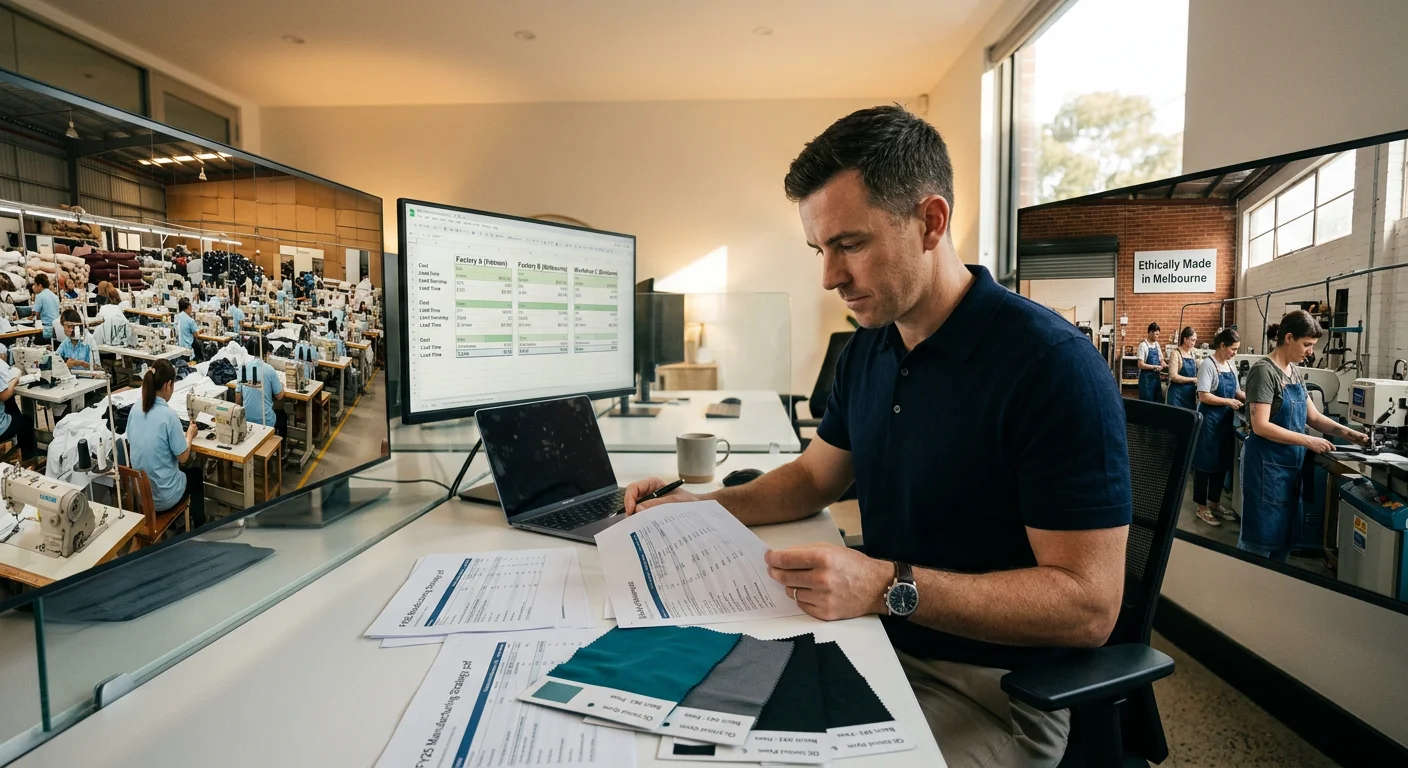
Sourcing from Asia at scale isn't a cost decision anymore — it's an operational discipline. The brands that get burned aren't the ones who chose the wrong country. They're the ones who treated quality control as a final step rather than a system built from day one.
Here's the framework that keeps your margins intact and your customer return rate under control.
Step 1: Factory Audits — Know Your Non-Negotiables Before You Wire a Deposit
Before any sample request, any price negotiation, any WeChat message — audit the factory. Not because it feels professional. Because it's the one way to know whether the unit economics you modelled will survive real production.
Social compliance certifications to verify:
BSCI — covers working hours, overtime pay, minimum wage, health and safety, and anti-discrimination. Over 2,400 member brands use this as a baseline requirement. No current BSCI report? Walk away.
WRAP — 12 principles covering labour compliance, hours, environment, and safety. Gold/Silver/Bronze levels. Many US activewear brands require Silver at minimum. Check the certificate and the audit date. Certificates older than 24 months mean nothing.
Material and quality certifications for activewear:
OEKO-TEX Standard 100 — tests finished garments and trims (zippers, elastic, thread) for harmful substances. For activewear worn against skin, push for Class II (direct skin contact) at minimum.
GRS (Global Recycled Standard) — your brand story involves recycled nylon or sustainable manufacturing? GRS certification on the fabric supply chain is a must. Require ≥50% recycled content for any sustainability claims in your marketing. No GRS, and you're exposed.
ISO 9001 — quality management systems certification. Major buyers require this from both sports garment factories and fabric suppliers. No ISO 9001 = higher operational risk.
Hardware checklist — what to look for on the factory floor:
Audit Point | Minimum Standard |
|---|---|
Flatlock / four-needle six-thread machines | ≥60% of total sewing equipment (high-performance factories run 65–75%) |
Metal detector (needle detection) | 100% finished goods scan, records retained ≥1 year |
Climate-controlled fabric storage | 20–26°C, 50–65% RH — prevents shrinkage variance in nylon/spandex |
Defect zoning | Three-zone physical separation: approved / pending QC / rejected — with single-direction flow |
Fire safety | Extinguisher ratios, clear evacuation routes, emergency lighting, annual drill records |
That fabric storage standard isn't optional for performance fabric suppliers. Nylon-spandex blends stored in uncontrolled humidity shift their cutting dimensions. Your size run arrives with variance built in before a single seam gets sewn.
Step 2: QC at Every Production Stage — Not Just at the End
Most founders run one final inspection before shipping. That's reactive quality management. By the time defects show up at final inspection, you've already lost weeks of production time. Your negotiating position is also weak — the goods are done.
Build quality control into three production stages.
Pre-Production: Lock the Details Before Fabric Gets Cut
Your tech pack is your legal document. It must include:
Full BOM with fabric GSM, fibre content, and width; trim brand and spec (thread weight like 40/2, zipper brand, silicone label compound type)
Stitch density: 12–14 SPI (stitches per inch) for high-stretch seam construction; edge binding can run 10–12 SPI — state this in writing
Flatlock tensile requirement: seams at critical stress points (crotch, shoulder, waistband) must hold ≥15–20N pull force without thread breakage — check this on the pre-production sample
Fabric recovery rate ≥85%: stretch the fabric, release it, and measure the return. Recovery below 85% means your legging loses compression integrity after 8–10 washes.
Run a PP (Pre-Production) Meeting and sign off a Golden Sample. Tag one physical sample "GOLDEN SAMPLE," enter it into the sample register, and attach fabric and trim swatches with batch and colour codes. This document becomes the reference point for every QC decision that follows.
One detail Australian brands often miss: your factory patterns are built on Asian fit models. Document the measurement gap between your factory's fit model and your target Australian customer (height, bust, hip) inside the tech pack. Fix it at pattern stage — not after you've received 800 units.
Mid-Production: Inline QA at the 20–50% Mark
Don't wait until the order is complete. Run a During Production Inspection (DPI) once 20–50% of units are finished.
Key checkpoints:
Cutting table audit: 10% random check on print/pattern alignment — maximum permitted offset is 0.5cm
First 50 units full inspection: check stitch tension, seam uniformity, and crotch triangle reinforcement (back-tack or reinforcement tape). Find skipped stitches, needle holes, or fabric rippling? Stop the line. Re-calibrate the machine and adjust needle gauge or thread weight before continuing.
Sampling method: use ANSI/ASQ Z1.4 or ISO 2859 sampling plans. Score high-risk zones (shoulder seam, crotch, waistband) as separate categories — these are the failure points that drive returns.
Final Inspection: AQL 2.5 as Your Floor
Third-party inspection through SGS, Bureau Veritas, or Intertek costs US$200–350 per batch. At 3,000+ units per run, that's under A$0.15 per unit. It's the cheapest insurance you can buy.
Use AQL 2.5 (General Inspection Level II):
Defect Category | Acceptance Level |
|---|---|
Critical (safety/function) | 0 — zero tolerance |
Major (visible defect, sizing error) | 2.5 |
Minor (cosmetic, non-functional) | 4.0 |
Specific checks for activewear:
Pilling on high-friction zones (seat, crotch, inner thigh) — run a Martindale test or physical abrasion simulation
Logo and silicone label adhesion — 45° or 180° peel test; minimum ≥1.5–2.0N/cm; document the heat press temperature, dwell time, and pressure settings
Key measurement tolerance: chest, waist, inseam within ±1.5cm; compression-fit styles tighten to ±1.0cm
Tie payment to your inspection report. Contract terms must state: final 70% payment releases after third-party inspection pass + bill of lading copy. Critical defects fail or measurement variance exceeds 2cm on any key dimension? You hold the right to withhold payment or require re-inspection and rework.
Step 3: Your Cross-Border Communication Tech Stack
Timezone gaps and language barriers kill production schedules. Build a communication system that cuts ambiguity before it creates defects.
Technical documentation — make it impossible to misinterpret:
Patterns and construction: use CAD/Gerber or Figma to produce pattern structure diagrams with seam allowances, zipper lengths, and armhole curves fully dimensioned
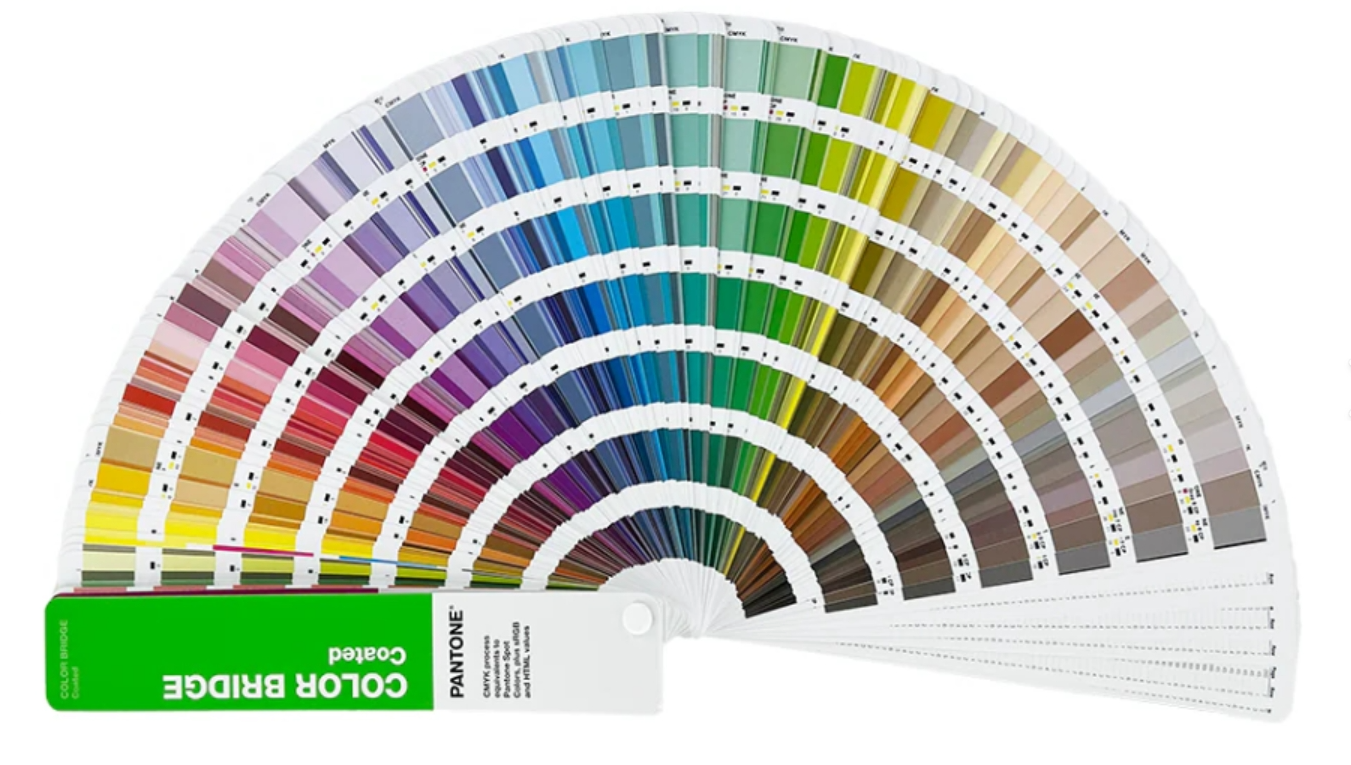
Colour management: specify Pantone TCX colour codes and physical Lab values. Require the factory to produce lab-dips with photograph and mailed physical swatch before bulk dyeing starts.
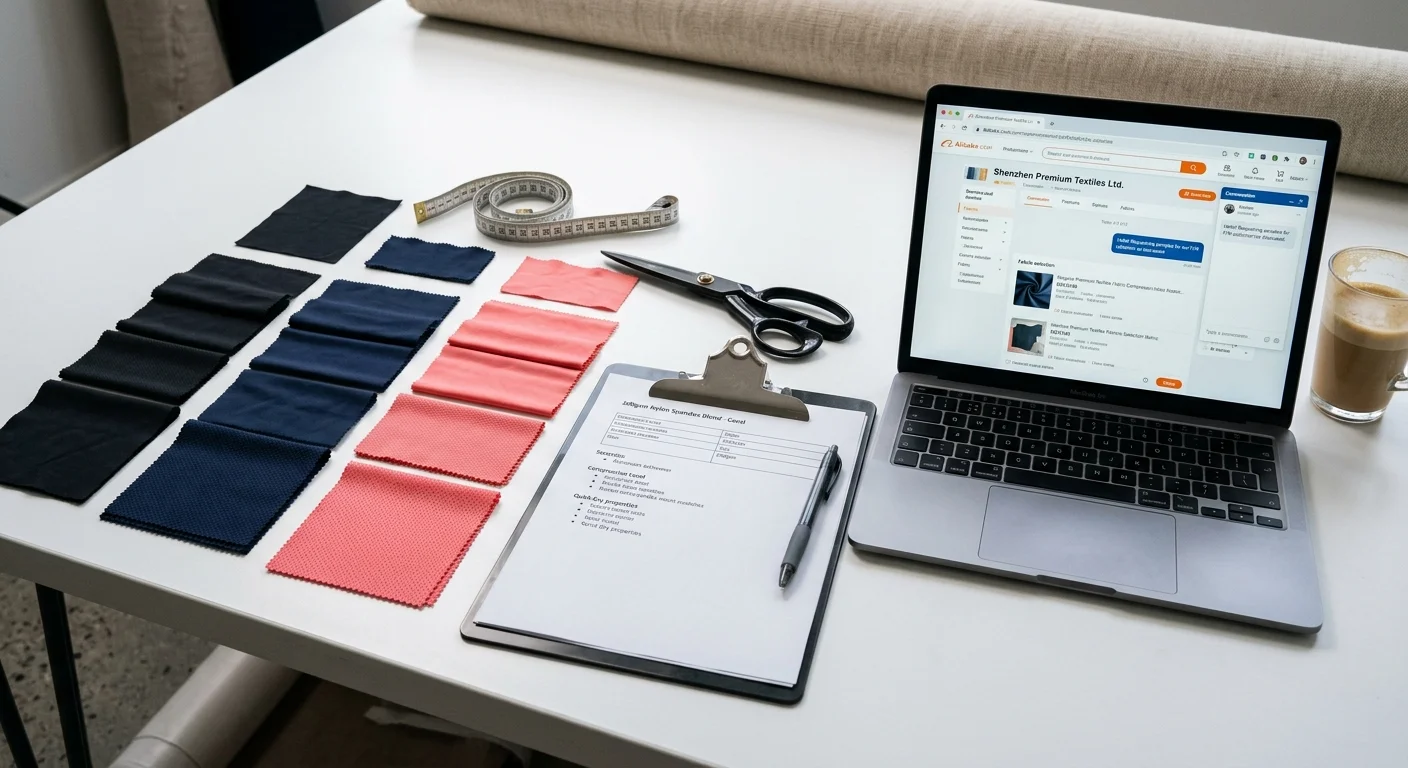
3D sampling: use CLO 3D or Browzwear to create virtual fit files. Send the 3D video to your Australian team for fit review on local body measurements before committing to physical sample revisions. This step alone cuts remote sampling revision rounds from 3–4 down to 1–2.
Production transparency — require real-time data, not end-of-week summaries:
Build a shared project board in Trello or Notion with these production stages as columns:
Fabric Received → Cutting → Sewing → Pressing → Packing → Shipped
Each column shows planned quantity versus actual quantity, with delay flags. Require your supplier to update every 48 hours with:
Output by style and size for that day
QC inspection records (rework rate, top 3 defect types)
A 30–60 second factory floor video — not a render, not a warehouse shot, an actual production line clip
Set up a shared Excel template for defect reporting: defect code (e.g., S1 = uneven seam, M2 = oil stain), quantity, defect rate percentage, photo reference number. This format makes week-over-week trend tracking automatic. You'll spot a quality deterioration pattern 2–3 weeks before it becomes a shipment problem.
Payment structure that protects your position:
Payment Stage | Amount | Trigger |
|---|---|---|
Deposit (T/T) | 30% | Capacity lock + raw material procurement |
Balance (T/T or L/C) | 70% | Third-party inspection pass + bill of lading |
Include a late delivery clause: 0.5% of outstanding invoice value per day for delays beyond 7 days. This isn't punitive — it shifts the factory's priority calculation when production slots are tight. Your order stops being the one that gets bumped.
Quality control in offshore garment manufacturing isn't a checklist you run at the end. It's a system you build from the moment you select a supplier. The brands that grow from 500-unit test runs to 3,000+ unit schedules each quarter aren't the ones with the lowest FOB price. They're the ones who made quality management non-negotiable at every stage — and built the documentation and communication tools to back it up across 7,000 kilometres.
Supplier Evaluation Scorecard: Copy-and-Use Scoring Matrix
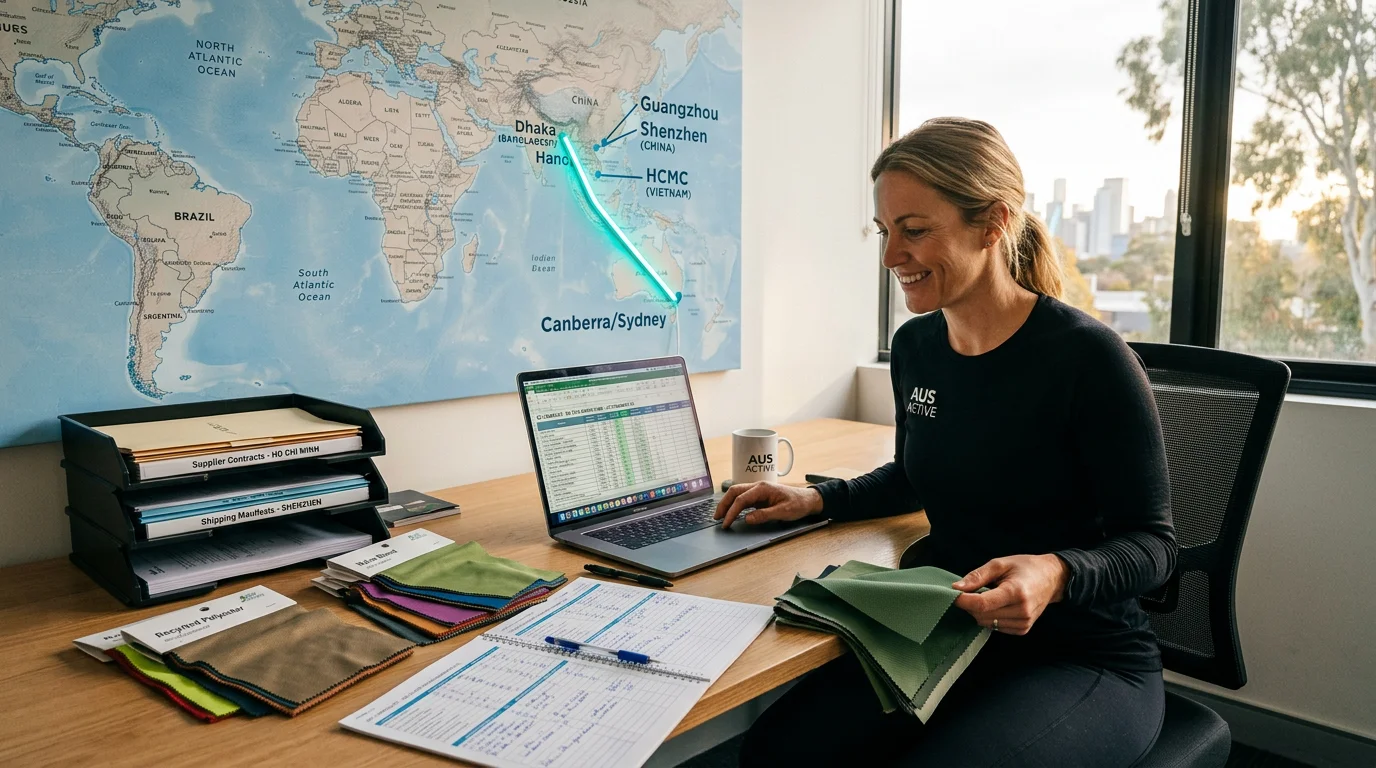
Stop collecting factory WeChat contacts in a spreadsheet with no system behind them. Most Australian activewear founders end up juggling 12 activewear supplier conversations at once — with no clear way to compare any of them. This matrix solves that problem.
Total: 100 points across three dimensions. One threshold. Clear action.
The Three-Dimension Scoring Framework
Dimension A — Production & Delivery Capability (40 points)
Criteria | Max Score |
|---|---|
Activewear/sportswear focus ≥3 years (not a T-shirt line that pivoted) | 8 pts |
MOQ ≤300 pcs/colour, or tiered pricing table available | 8 pts |
Fabric library covers 200–260gsm nylon/spandex; colour cards available on request | 8 pts |
Flatlock, seamless knit, or laser-cutting equipment on floor | 8 pts |
Zero customs holds or major delivery breaches in past 12 months | 8 pts |
Dimension B — QC Systems & Compliance (35 points)
Criteria | Max Score |
|---|---|
Valid BSCI / WRAP / OEKO-TEX / GRS audit report | 7 pts |
Accepts SGS / Bureau Veritas / Intertek AQL third-party inspection | 7 pts |
Commits to golden sample sign-off + lab testing (colourfastness, pilling, formaldehyde) | 7 pts |
Defect tracking traceable to individual operator or machine number | 7 pts |
Labels meet AS/NZS 2622 and Australian Consumer Law standards | 7 pts |
Dimension C — Flexibility & Brand Services (25 points)
Criteria | Max Score |
|---|---|
Tech pack to first sample ≤15 days; revision feedback ≤48 hours | 8 pts |
Supports private label, custom woven labels, and heat-transfer silicone branding | 8 pts |
Bilingual account manager, response within 4 business hours across time zones | 5 pts |
Sample cost credited against bulk order; reorder rebate available each quarter | 4 pts |
Decision Thresholds
Score | Action |
|---|---|
≥85 points | Qualified — proceed to sampling and trial order |
70–84 points | Conditional — require video factory walkthrough or 50-unit trial run first |
<70 points | Eliminate |
Hard Filters: Run These Before Scoring
Not every criterion gets a score. Some are straight disqualifiers.
MOQ >300 pcs/colour → cut from shortlist now
Refuses AQL third-party inspection → elevated risk, do not proceed
No traceable QC records → not suitable for a long-term brand partnership
Activewear experience <3 years → downgrade or exclude
Good bonus signals to watch for: tiered pricing sheets, small-batch fast-turn capability, prior Australian market or label compliance experience, and suppliers who send fabric handfeel cards or test reports without being asked.
Supplier Comparison Tracker: Column Headers to Copy
Supplier Name | Country/City | Core Category | Est. Year | MOQ (pcs/colour) | Equipment (Flatlock/Seamless/Laser) | Certifications | AQL Accepted | Lab Tests | AS/NZS 2622 Compliant | Sample Lead Time (days) | Revision Response (hrs) | Bilingual Contact | Score A | Score B | Score C | Total | Status
Auto-status formula: =IF(Total>=85,"Qualified",IF(Total>=70,"Conditional","Eliminate"))
Run three suppliers through this matrix at the same time. Your decision stops being a gut call — and starts being a number.
Conclusion
The spreadsheet doesn't lie — but it doesn't tell the whole story either.
Your sourcing decision isn't about Asia versus Australia. It's about matching your supply chain to your current stage — not the stage you plan to reach in 18 months.
Bootstrapping 200 units to test demand? Local production keeps you agile. Scaling past 3,000 units per month? Offshore costs become hard to overlook.
Brands that thrive don't chase "perfect production." They make decisions with real numbers, not forum opinions. That's the difference.
You now have the cost benchmarks, the decision framework, and the supplier scorecard. Use them.
Here's what to do next:
Pull up that evaluation matrix
Contact three gym wear suppliers this week — not next month
Run your numbers through the stage-based decision tree
In private label activewear , the brands winning in Australia right now didn't find a perfect fitness wear manufacturer. They found the right one for right now — and shifted their approach as they grew.
That's your edge. Go use it.