OEM Service Pipeline · Tech Pack to FOB

OEM Yoga Apparel Service. From tech pack to bulk in 25-30 days.

Five operational stages — tech-pack interpretation, pattern and marker, sampling, bulk production, QC and shipment. One PM per PO. Daily WhatsApp updates. Pattern tolerance ±0.5 cm. Delta-E <3 on colour. The numbers below are the same ones we lock into the PO acceptance email.

25–30
Working days, PO to FOB
5
Operational stages
±0.5 cm
Pattern PoM tolerance
<3
Delta-E on colour
<1.8%
Pre-pack defect target
1
Dedicated PM per PO

Stage Gantt · Day 1 → Day 30

1 · Tech-pack read clarification log + frozen spec
D1–3
2 · Pattern + marker graded XS–3XL, marker > 82% eff
D3–7
3 · Sampling proto → fit → PP → gold seal
D7–15
4 · Bulk production line A / B / C, CP1–CP5 inline QC
D15–25
5 · QC + shipment AQL 2.5 · pack · docs · FOB
D25–30
Stage 1 → 5

Five stages. Same coordinator. One PM email thread.

An OEM run is not one project — it is five sub-projects in sequence. Each stage has a named owner inside our team, an explicit deliverable, and a calendar window. If a stage runs long, the next stage absorbs the slack only when the spec allows; otherwise the PM rebooks the FOB date in writing. No silent slippage.

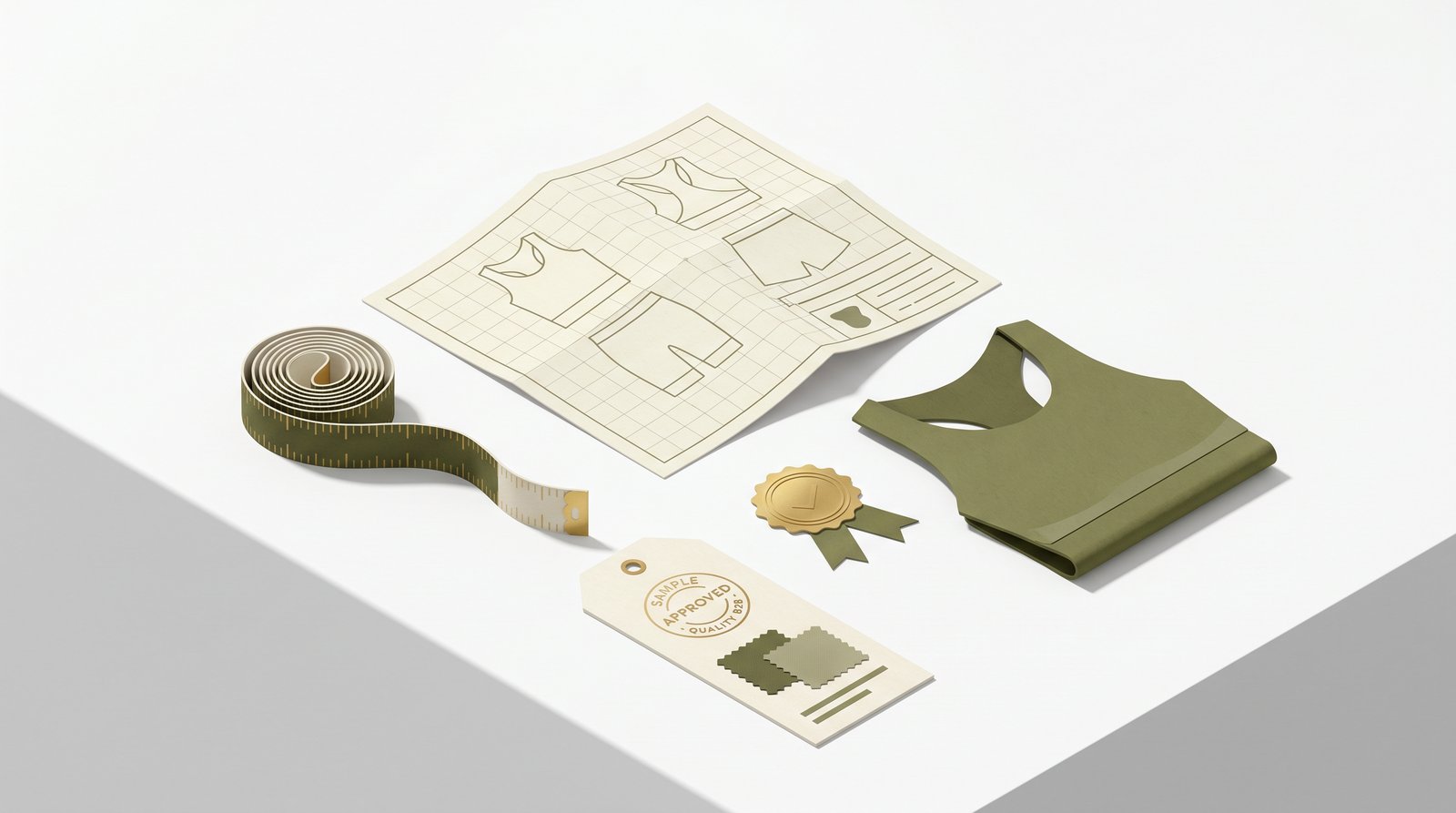
OEM workflow flat-lay: blueprint tech-pack sheet, measuring tape, sample hangtag, gold approval seal in olive and cream palette
01 Tech-pack read Days 1–3

Tech-pack interpretation — turn the brief into a frozen spec.

Who handles
Senior patternmaker + production planner + QC lead
What we produce
Clarification log grouped by garment piece, then a frozen spec sheet and a written confirmation of fabric, trims, and decoration techniques.
Days on the calendar
1–3 working days from receipt of the complete tech-pack package.
Deliverable to buyer
Signed-off clarification log + frozen spec sheet + written confirmation of materials and decorations.

Common findings at this stage: missing gsm spec on lining fabric, undefined elastic width on waistband, no Pantone reference on accent stripe, hangtag artwork supplied at 150 dpi instead of 300 dpi. We do not start pattern work with any of these open.

02 Pattern + marker Days 3–7

Pattern and marker — graded files, fit-intent memo, marker efficiency on record.

Who handles
Patternmaker (lead) + grader + cutting-room supervisor
What we produce
Graded patterns across XS–3XL (or buyer's range), marker layout for fabric utilization, fit-intent memo describing seam allowances, ease points, and stretch direction.
Days on the calendar
4–5 working days, parallel to Stage 1 closing.
Deliverable to buyer
Digital pattern files (DXF or AAMA), printed graded set, marker efficiency report. Target marker efficiency > 82%; the number lands on your desk before pattern-cutting starts.

Pattern modifications welcomed at this stage: rise, inseam, neckline depth, strap width, hem length, pocket placement. Late modifications (after marker is cut) are not free — we publish the rework fee in writing before proceeding. See OEM sample policy and revision-round fees for the schedule.
03 Sampling Days 7–15

Sampling — proto, fit, PP, gold seal. Bulk does not start without all four signed.

Who handles
Sample sewers on Line D + sample coordinator + dedicated QC inspector
What we produce
Proto sample (construction proof), fit sample (1 size point), PP sample (pre-production in actual bulk fabric), gold seal (signed reference for inspection).
Days on the calendar
5–9 working days for proto + fit, 3–5 working days each for revision rounds. PP sample lands on Day 13–15 in the standard window.
Deliverable to buyer
Physical samples couriered DDP within the agreed lead-time window. Photo set per sample on the same day it leaves the line.

What we will not skip: PP sample sign-off in writing. The PP sample becomes the contractual reference for AQL 2.5 inspection downstream. Skipping PP is the single most expensive shortcut in OEM — we will not run bulk without it.

04 Bulk production Days 15–25

Bulk production — gold seal becomes the line standard. CP1–CP5 inline QC running.

Who handles
Production planner + bulk-line operators (Line A / B / C by garment family) + 2 inline QC inspectors per line.
What we produce
Graded, cut, sewn, decorated, trimmed garments matched against the gold-seal PP sample at every checkpoint.
Days on the calendar
8–14 working days for 200–1,000 pcs; 15–22 working days for 1,000–3,000 pcs. Orders > 3,000 pcs split across two scheduling windows with milestones published on Day 15.
Deliverable to buyer
Daily WhatsApp updates from the PM (photos + carton count + line status). Production stage card visible on every batch. Inline QC at five checkpoints — CP1 cutting, CP2 mid-line, CP3 pre-pack, CP4 AQL 2.5 pull, CP5 final pre-shipment.

Halt authority: any CP3 or CP4 inspector can stop a batch from advancing without escalation. We backstop with a same-shift root-cause review on the floor — not a written report two days later. Line allocation is decided by SKU family on the PO acceptance email; see yoga apparel manufacturing capacity and line allocation.

05 QC + shipment Days 25–30

QC and shipment — AQL pull, pack, docs, lane handoff.

Who handles
QC lead + packing supervisor + logistics coordinator
What we produce
Final AQL 2.5 pull (or AQL 1.0 if PO contract requires), polybag + carton + master-carton labelling, commercial invoice, packing list, certificate of origin, HS-code, FNSKU labels if FBA-bound.
Days on the calendar
3–5 working days for QC + pack + paperwork. FOB handover on Day 28–30 in the standard window.
Deliverable to buyer
Pre-shipment inspection report (with photos), packing list confirmed against PO, third-party inspection welcomed (SGS / BV / Intertek). Buyer-arranged direct, or coordinated through us at the inspector's published rate (no markup).

Lane handoff: the same logistics coordinator who packed the order books the lane (FOB / CIF / DDP / FBA-direct). Lane choice was decided on the PO acceptance email, not after pack-out. Customs paperwork is filed on every cross-border shipment — buyers do not touch HS-codes.

The 5-stage workflow is invariant across every OEM run. What scales between tiers is the PM bandwidth and the sample turnaround speed — see OEM service tiers below for the bracket-by-bracket breakdown, and the OEM yoga apparel pricing tiers and MOQ schedule for the per-piece rate by volume.

Tech Pack Readiness

The eight files we need before Stage 1 starts.

Day 1 of the workflow only begins when the package below is complete. A partial tech pack means our patternmaker starts on Day 4 instead of Day 1, and the FOB date moves accordingly. Use this list to package the brief in one delivery — not eight separate emails over three weeks.

# File What's in it Format Required?
01 Spec sheet Every dimension across the size range, seam allowances, fit intent, points of measure with tolerances. XLSX / PDF Required
02 BOM (bill of materials) Every fabric, trim, label, hangtag, polybag — with supplier preference if any. XLSX Required
03 Fabric swatch Physical swatch or named mill reference. We re-source from our tier-1 list if requested, at-cost. Physical + photo Required
04 Fit notes How the garment should sit on the body — sketch annotations on body silhouette, ease points called out. PDF Required
05 Branding artwork Logo, woven label, hangtag, polybag print — vector preferred for crisp scale across garment placement. AI / EPS / PDF 300 dpi Required
06 Pantone / colour references Pantone TCX/TPG codes for solid colours; hex values for sublimation. Monitor screenshots do not qualify as colour specs. TXT / PDF Required
07 Reference garment One piece in the closest existing fit — your own previous run, or a benchmark. Couriered to the pattern desk. Physical Strongly preferred
08 NDA (mutual) If branding or design is confidential, the mutual NDA is signed before any tech-pack file changes hands. PDF Optional

What we do not need at this stage: 3D renders, mood boards, or competitor screenshots. If your brief is still at that stage, the ODM yoga apparel design service is the right intake — we draft the tech pack with you and route into the same 5-stage workflow afterwards.

Sample Sign-off Ladder

Four sample stages. Each one approved in writing before the next is cut.

Sample sign-off is the one part of OEM where speed is the enemy. A bulk run on a fit sample that was never PP-signed is the most expensive mistake a buyer can make — it shows up at AQL inspection as a 20% out-of-spec batch and a hard conversation. Below is the four-stage gate we hold every PO to, with the approval criteria for each.

Stage A · Proto

Construction proof in nearest in-stock fabric.

  • Built in: closest in-stock fabric (not bulk fabric). Purpose is to prove construction works, not to ship.
  • Buyer signs off on: seam architecture, panel layout, decoration placement, trim attachment method.
  • Approval criteria: construction matches tech-pack diagrams. Seam-pull test passes. No silent substitutions.

Lead time4–6 working days · revision rounds 3–5 days each

Stage B · Fit

Actual bulk fabric, single size point on body.

  • Built in: actual bulk fabric, single size point (usually Medium or the buyer's reference size).
  • Buyer signs off on: every measurement against spec sheet, fit on body silhouette, stretch behaviour under load.
  • Approval criteria: every spec-sheet PoM within ±0.5 cm. Fit intent matches the fit-notes file.

Lead time4–6 working days · revision rounds 3–5 days each

Stage C · PP

Full pre-production sample. The contractual reference.

  • Built in: actual bulk fabric, all trims, all decorations, full grading proven across 2–3 size points.
  • Buyer signs off on: the PP sample becomes the contractual reference. Everything that ships must match the PP.
  • Approval criteria: every PoM ±0.5 cm across the bracket. Colour reading Delta-E <3 against Pantone reference. Decoration scale and placement match PP photos.

Lead time5–7 working days · cannot be skipped on any OEM run

Stage D · Gold seal

Sealed reference for QC during the bulk run.

  • What it is: one PP-signed sample retained on our floor + one couriered to the buyer. Sealed tag, both signatures.
  • How QC uses it: AQL inspectors compare garments against the physical gold seal piece, not a photo or a tech-pack page.
  • When it lands: Day 13–15 of the standard timeline, before bulk-line kickoff on Day 15.

Retention18 months on-floor · 18 months at buyer end

Sample fees, courier costs, and revision-round billing are itemized on the OEM sample policy and revision-round fees page — including which revisions are absorbed, which are billable, and the rework fee schedule when a buyer changes a spec after PP sign-off.

Production Tracking

A daily message. Not a quarterly status report.

Production transparency is not a portal. It is a person on WhatsApp at the same time every day with a structured update. Below is what a buyer can expect to receive from Day 15 (bulk kickoff) through Day 28 (pack-out) — and how the photo log, the stage card, and third-party inspection slot in.

Daily WhatsApp update (Mon–Sat, 17:00 GMT+8)

Same person, same time, every day
  • Sender: the dedicated PM for this PO — one named person, not a shared mailbox.
  • Content: today's cut count, today's sewn count, today's QC pass count, % complete vs PO schedule, any defect cluster found and action taken, tomorrow's plan.
  • Format: 5–7 line text + 2–3 photos from the floor — actual garments in the actual stage they're in.
  • What this is not: a marketing photo, an artistic shot, or a "behind the scenes" reel. It's a working photo of the garment in the operator's hand.

Production stage card on every batch

Physical card, updated daily
  • What it is: a printed card hanging at the head of each batch on the line.
  • Card shows: PO number, buyer reference, current stage (cutting / sewing / decoration / QC / packing), expected ship date, PM name.
  • Why it exists: any operator or QC inspector sees at a glance which PO a piece belongs to. No "whose order is this" confusion.
  • For floor visits: buyers who visit can recognize their own order without a tour guide leading them there.

Photo log archive (Google Drive or buyer's storage)

Indexed by date · 18-month retention
  • Folder created: at PO acceptance, indexed by date and by stage.
  • What goes in: every WhatsApp photo, plus stage-completion photos at end of Cutting / Sewing / Decoration / Pre-pack QC / Pack-out.
  • Retention: 18 months after FOB. The buyer's archive of what actually shipped.
  • Buyer's storage instead: we'll mirror the folder into your preferred storage (Dropbox, OneDrive, Notion, internal portal) if requested at PO acceptance.

Third-party inspection welcomed at any stage

SGS · BV · Intertek · AsiaInspection
  • Welcomed at any stage: proto, fit, PP, mid-bulk, pre-shipment — whichever the buyer chooses.
  • Our role: coordinate floor access, prepare AQL sample tables, stand behind any finding.
  • We do not: negotiate with inspectors on behalf of the buyer. Their report is their report.
  • Cost: buyer-arranged direct, or coordinated through us at the inspector's published rate — no markup.

The same tracking SOP runs across the custom yoga apparel manufacturer overview programme, the ODM yoga apparel design service intake, and every line on the production floor — the daily message is not a tier upgrade, it is the standard for every PO.

OEM Guarantees

Four guarantees we put in the PO acceptance email — not in a brochure.

A guarantee that isn't written into the PO acceptance is a slogan. We put four numbers in writing on every OEM run — not on a marketing page, in the email that confirms the PO. Below is what the four numbers mean and how we measure them.

01Pattern accuracy

Every PoM across every size, within ±0.5 cm.

±0.5 cm

What it covers
Every point of measurement on the spec sheet, across every size in the bracket.
How we measure
PP sample inspected against spec at every PoM. Bulk inspected at AQL 2.5 random pull at CP4, plus 100% inspection on any garment that fails seam-pull or stretch test.
Out-of-tolerance handling
Any garment outside ±0.5 cm at AQL pull triggers a 100% inspection of the affected batch. Rework or replacement, our cost.

02Colour accuracy

Spectrophotometer reading, lot vs Pantone, Delta-E < 3.

ΔE < 3

What it covers
Every dyed fabric, every sublimation print, every screen-print spot colour.
How we measure
Spectrophotometer reading on bulk lot vs Pantone reference (TCX for fabric, TPG for print). Three readings per lot, averaged.
Out-of-tolerance handling
Lot reading ΔE ≥ 3 triggers a re-dye on the affected rolls before cutting. Sublimation re-print on the affected garments before assembly.

03Pre-pack defect rate

CP3 100% inline visual, target < 1.8%.

< 1.8%

What it covers
Defect rate measured at CP3 (pre-pack inline inspection), counted as defective garments / total garments inspected.
How we measure
100% inline visual at CP3, sample-pull AQL 2.5 at CP4. Defect categories tracked separately (major / minor / critical).
Out-of-tolerance handling
Any batch above 1.8% at CP3 holds for root-cause review before AQL pull. The PO ships clean or it does not ship.

04Written acceptance

Every number above lives in the PO acceptance email.

PO email = contract

What it covers
Every guarantee above is written into the PO acceptance email at the moment we accept the PO.
How we measure
The email is the contract. The buyer holds a record of every number that was promised at PO acceptance.
Out-of-tolerance handling
Any miss triggers a written root-cause report inside 72 hours of detection — plus the remedy and the timeline. We report the break, not just the recovery.

What we do not guarantee: zero defects (anyone who claims that is shipping rework as inventory), 100% colour match to a backlit monitor reference (you must send a physical Pantone TCX/TPG card), or lead-time hold if the buyer's sign-off lags past the agreed window. Each of these is documented on the OEM sample policy and the OEM pricing tiers and MOQ schedule.

Service Tiers

Three tiers. Same workflow. Different PM bandwidth.

The 5-stage workflow is identical at every tier. What scales is PM bandwidth, sample turnaround speed, and whether a Gantt-style schedule with milestone dates is published by week 1. Pick the tier that matches the volume and the timeline pressure of the PO — downgrade is automatic if annual volume falls below the bracket, no contract gymnastics.

Tier 1 · Standard

50–300pcs per SKU

Capsule launches, first-PO buyers, proof-of-concept runs. The right intake when the SKU is new to the catalog.

  • PM model: shared PM — one PM coordinates 4–6 Standard POs at once.
  • Sample turnaround: standard window — Proto 5–6 d, Fit 5–6 d, PP 6–7 d.
  • Tracking: daily WhatsApp updates + photo log (same as Pro / Enterprise).
  • Pricing: per-piece OEM rate. No PM surcharge. Sample fees per published sample policy.

Lead time25–30 working days

Tier 2 · Pro

300–1,000pcs per SKU

Scaling brands, repeat OEM partners, brands placing 2–4 POs a year on the same patterns.

  • PM model: dedicated PM — your POs only, typically 2–3 Pro POs in rotation.
  • Sample turnaround: expedited — Proto 4–5 d, Fit 4–5 d, PP 5–6 d.
  • Tracking: daily WhatsApp + weekly Loom video walkthrough of the line during bulk + photo log.
  • Pricing: volume-tier rate. Sample fees discounted 20%. No PM surcharge.

Lead time22–28 working days

Tier 3 · Enterprise

1,000+pcs per SKU · or 3,000+ annual

Established brands, multi-SKU programs, recurring annual buys, retail-channel OEM with hard delivery windows.

  • PM model: dedicated senior PM + backup PM. Quarterly business-review video call.
  • Sample turnaround: priority — Proto 3–4 d, Fit 3–4 d, PP 4–5 d. Sample line capacity held for Enterprise.
  • Tracking: daily WhatsApp + weekly Loom + Gantt-style schedule with milestone dates by week 1 + factory visit invitation.
  • Pricing: annual volume rebate. PP and gold-seal sample fees absorbed. Pattern archive ring-fenced for re-order continuity.

Lead time20–32 working days

Enterprise tier requires an annual letter of intent confirming the volume bracket. Tier downgrade from Enterprise to Pro happens automatically if annual volume falls below the threshold — we re-quote at Pro pricing on the next PO, no renegotiation theatre. The full bracket-to-bracket pricing logic is published on OEM yoga apparel pricing tiers and MOQ schedule.

Written reply within 1 business day. No auto-reply, no chatbot — a real PM reads every brief and pulls a schedule.