Choosing made in USA custom sports bra production goes beyond sourcing. It shapes your brand from the ground up — your margins, your timeline, your quality ceiling, and the story you tell your customers.
Most information out there treats domestic manufacturing as one thing: vague, expensive, and complicated. That's not the full picture. The reality is more workable than that.
US-based cut-and-sew factories for sports bras across Los Angeles, New York's Garment District, and North Carolina's textile corridor. Some run low MOQs that make sense for an emerging brand.
This guide gives you the operational clarity to move fast:
Real cost benchmarks
A 14-dimension factory evaluation framework
An 18-week production roadmap — from first inquiry to bulk delivery
No filler. No fluff. Just what you need to make smart decisions and get moving.
US Regional Manufacturing Clusters & Capability Mapping
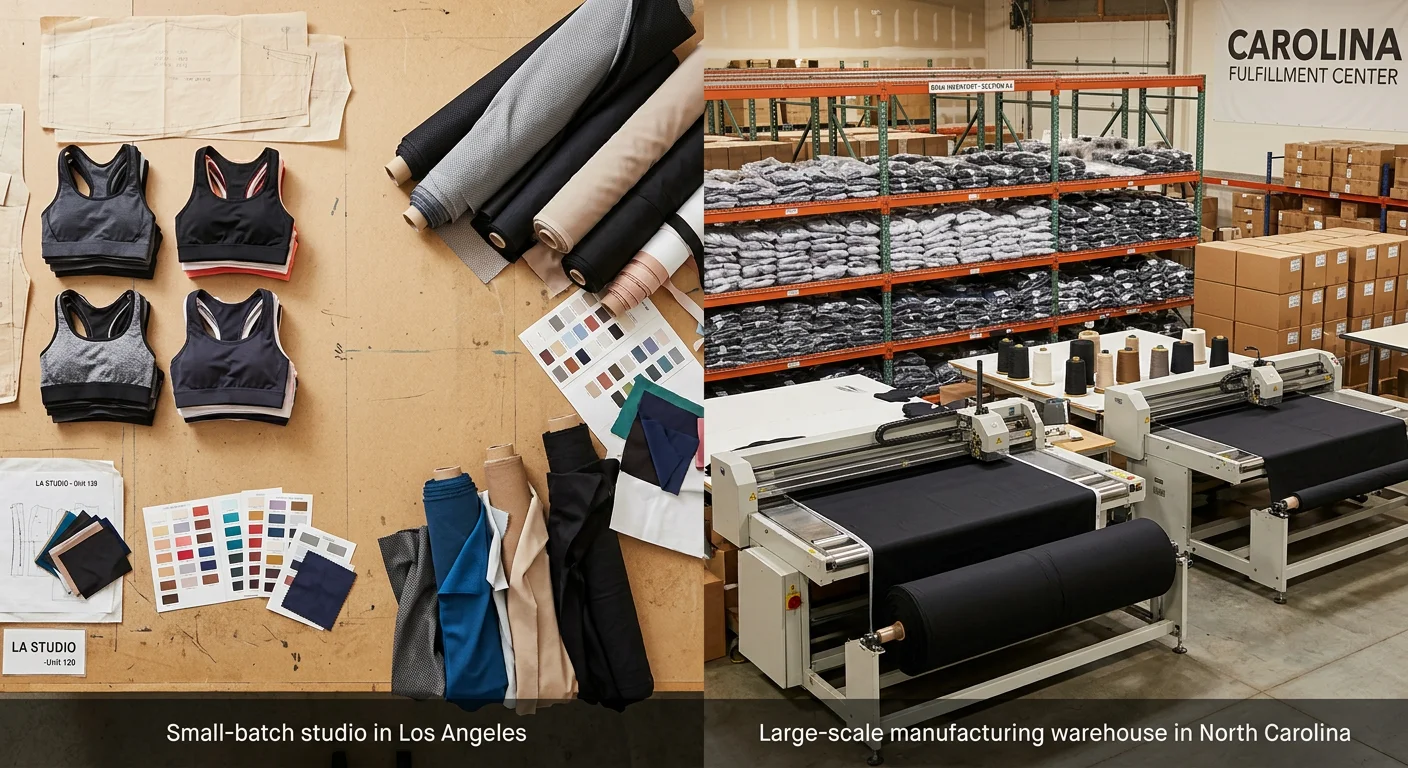
Four manufacturing ecosystems shape American sports bra production — and each one serves a different brand profile. Where you source isn't just a logistics decision. It's a strategic one.
Here's how the geography breaks down.
Los Angeles: The Startup-Friendly Cluster
The LA Fashion District and San Fernando Valley (Sylmar, Van Nuys, Pacoima) is where most emerging custom sports bra brands get their start on home soil — and for good reason.
The density of cut-and-sew specialists here is unmatched. Most contractors run MOQs of 50–200 units per style/color . Micro-shops can drop below 50 if your patterns are ready to go. Pattern iteration turnaround runs 3–5 days for complex multi-panel constructions — racerbacks, adjustable straps, hook-and-eye closures, power mesh panels.
San Fernando Valley production units run 20–60 sewing heads on average. That's the sweet spot for runs between 200–2,000 units per style . DTC founders who need rapid fit testing and multiple prototype rounds before locking a high-impact style will find this cluster the most practical starting point.
Best fit: Early-stage brands. Fast prototyping. Frequent fit updates.
New York / New Jersey: Technical Fabric Access + Premium Construction
The NYC Garment District doesn't manufacture in volume the way LA does. What it offers instead is a different kind of advantage: proximity to performance fabric.
Importers and jobbers between 39th–41st Streets stock nylon/spandex, compression knits, moisture-wicking mesh, and European technical fabrics from Italian and Taiwanese mills. Buying fabric here cuts lead times to 2–6 weeks — versus 8–12 weeks on direct imports.
The NJ and Brooklyn corridor adds seamless and circular knitting capabilities (Santoni machine operations), ultrasonic bonding, and heat-seal taping for low-chafe bra construction. Production volumes run 1,000–10,000 units per style per season . Orders are often split across a Manhattan pattern room and a New Jersey production floor.
Labor costs here are the highest of any domestic cluster. That's the trade-off for clean bonding lines, precise sizing grading (US + EU standards), and QC consistency that supports a premium price point .
Best fit: Established performance brands. Higher-SKU seasonal programs. EU/UK market expansion.
Pacific Northwest & Mountain States: The Sustainability Cluster
Portland, Seattle, Denver, Boulder, Salt Lake City — this cluster is built for brands whose supply chain is the story.
Factories here work with recycled ECONYL and REPREVE nylon , bluesign and OEKO-TEX certified textiles, and organic blends. Many operate under SA8000-style labor standards even without formal certification. The region pairs manufacturing with West Coast 3PL fulfillment , giving DTC brands a real "low-carbon, Made in USA" narrative — not just a marketing claim. It's built into the structure.
Production capacity runs 100–3,000 units per style . Fabric costs run a bit higher due to certified material premiums. Brands in this cluster price to match, and customers expect it.
Best fit: Mission-driven DTC brands. Sustainability-forward positioning. Moderate volume, premium margins.
Georgia / Carolinas: High-Volume, Low-Cost, Fully Integrated
The Southeast is where American textile manufacturing has its deepest roots — and still its strongest capabilities. The Carolinas and Georgia corridor runs fiber → yarn → fabric → dye → cut-and-sew under one regional infrastructure no other cluster can match.
Plants here are built for scale: 1,000 to 100,000+ units per order . You get automated Gerber and Lectra cutting lines, dye-sublimation printing at 1,000+ units per day , and labor costs running 10–25% below NYC and LA benchmarks.
Logistics are a structural advantage too. Atlanta's air and trucking hub, plus Savannah and Charleston ports, keep inbound fabric and outbound finished goods moving on schedule. East Coast and Midwest distribution centers receive ground shipments within 1–3 days .
Best fit: Wholesale programs. Team and promotional apparel. Sublimation-heavy styles. Volume-driven private label.
Cluster Comparison at a Glance
Region | MOQ Range | Relative Labor Cost | Best For |
|---|---|---|---|
Los Angeles | 50–500 units | High | Prototyping, DTC startups |
New York / NJ | 500–10,000 units | Highest | Premium brands, EU sizing |
Pacific NW / Mountain | 100–3,000 units | Moderate | Sustainability brands |
Georgia / Carolinas | 1,000–100,000+ units | Lowest | Wholesale, high volume |
Pick the cluster that matches your current production stage — not where you hope to be someday. A 300-unit DTC launch belongs in LA. A 15,000-unit private-label program belongs in the Carolinas. Getting that fit wrong at the start is an expensive lesson.
Domestic vs. Offshore Cost Benchmarks & MOQ Realities
The numbers are what they are. Domestic manufacturing costs more per unit. That's the starting point — plan around it honestly, and it stops being a problem.
Here's the real financial picture for made in USA custom sports bra production, with no softening.
Sampling & Development Costs
Your first investment happens before a single production unit exists.
For cut and sew sports bra production USA , domestic sampling runs $200–$800 per style . That range isn't arbitrary. It reflects real cost layers:
Pattern creation : An independent patternmaker charges $45–$90/hr . At 4–8 hours per style, you're looking at $180–$720 for pattern and initial proto alone.
Flat development packages : Many LA and NYC cut-and-sew studios offer bundled pricing — $250–$600 per style covering pattern, one prototype, and a basic spec sheet.
Fit revisions : Budget 2–3 physical rounds for any high-impact design. Each revision adds sewing labor at $40–$135 per sample , plus fit model time at $50–$150/hr .
A realistic all-in development budget for a compression bra with two fit sessions and three sewn samples lands at $600–$900 . Simpler low-support styles run $200–$400 .
MOQ Realities: Cut-and-Sew vs. Seamless
Cut-and-sew domestic shops — the main path for most emerging brands — run:
50–300 units per style as a standard floor for sports bras
30–50 units at micro-batch incubator factories — but unit costs run 30–60% higher than standard 200–300 unit tiers
Simpler styles can qualify at 25–50 units per color . Complex multi-panel bras need 100–300 total units before pricing makes sense
Domestic seamless production works under a different set of economics. Circular knitting machine setup and yarn changeover make sub-300 runs unworkable. Most US seamless houses require:
300–500 units per style/color as a hard floor
Machine setup fees of $500–$1,500 as an option instead of raising MOQ on small runs
Shared-body programs — you adopt a standard knit silhouette and customize color and branding yoga sports bra — can bring seamless MOQs down to 150–250 units per color
Compare that to offshore. China, Vietnam, and Indonesia post 300–600 units per style/color as standard. Larger factories want 1,000–2,000 units for best pricing. Sub-MOQ offshore orders carry 10–25% price surcharges . The gap between domestic and offshore minimums is narrower than most founders expect.
Unit Cost Architecture: Where the Money Goes
Domestic sports bra OEM production requires clear, honest math. Here's how the numbers break down:
Cost Component | Basic/Light-Support Style | High-Impact Compression Style |
|---|---|---|
Materials (fabric, trims, cups) | $4–$9 | $7–$14 |
Labor (sewing, assembly) | $7–$12 | $12–$20+ |
Overhead & factory margin | $4–$6 | $9–$12 |
Ex-factory total (USA) | $15–$22 | $28–$45 |
The labor line tells the real story. US operators earn $15–$30/hr in base wages. Loaded with benefits and overhead, factories bill that at $25–$45/hr . A multi-panel high-impact bra takes 20–45 minutes of sewing time . Run that math and unit labor cost alone hits $9–$34 — before a single inch of fabric is cut.
Offshore FOB unit costs for comparable styles:
Basic/light styles : $3.50–$7.00 at 600–1,000+ units
High-impact, multi-panel styles : $6–$18 FOB
That's a real gap — 40–70% lower offshore CM costs , driven by labor arbitrage. The gap shrinks fast once you factor in the full landed cost picture:
Import duties on finished sports bras : 10–16% MFN tariff into the US
Ocean freight : $0.20–$0.80/unit; air freight : $1.50–$4.00+/unit
Hidden offshore cost uplift from communication lag, rework, and QC failures: industry estimates put this at 15–30% of the initial quote on first orders with new factories
Lead Time Is a Cost Too
Domestic production timeline for a new sports bra style:
Sampling to approved proto: 3–8 weeks
Production (small batch): 6–12 weeks from PO
Total concept-to-delivery: 12–20 weeks
Offshore from Asia :
Sampling alone: 6–12 weeks (time-zone and communication lag included)
Production: 8–16 weeks
Ocean shipping: 3–6 weeks port-to-warehouse
Total concept-to-delivery: 24–32+ weeks — and that's optimistic for a first order
For a B2B Activewear Supplier domestic relationship, that 12-week difference is working capital. Shorter cycles mean smaller safety stock, less markdown risk, and faster reaction to sell-through data. Most brands run tight on cash. Those savings are real, even at a higher unit cost.
The Honest Financial Modeling Framework
Run both scenarios for each new style before committing:
Domestic (USA)
- Sampling: $200–$800/style
- MOQ: 100–300 units at standard pricing; drop below that and add 20–40% to unit cost
- Unit cost: $15–$22 (basic) / $28–$45 (high-impact)
Offshore (Asia)
- Sampling: $300–$600/style — plus freight on samples and longer revision delays
- MOQ: 300–1,000+ units/style/color
- Unit FOB: $3.50–$7 (basic) / $6–$18 (high-impact)
- Add duties, freight, and a 15–25% hidden cost buffer before comparing landed cost
Brands that struggle with domestic manufacturing are the ones comparing ex-factory prices without running the full landed cost model. Run the full model. The decision gets a lot clearer.
14-Dimension Manufacturer Evaluation & Screening Framework
Most brands that get burned by domestic sports bra manufacturers didn't choose wrong. They just didn't know what to ask.
The factory toured well. The samples looked clean. The price was workable. Then bulk production arrived. Seam allowances were inconsistent. Compression recovered unevenly. Band elastic rolled after six washes. None of that showed up in the two prototypes they approved.
This is a screening system built to catch those problems before they become your inventory. Fourteen dimensions. Each one maps to a specific failure mode. Work through them in order before you sign anything.
Dimension 1: Technical Construction Expertise
Sports bra production is not general sewing. Ask for documented evidence of encapsulation versus compression construction — molded or spacer-foam cups for high-support styles, double-knit compression panels for compressive styles. You want to see at least three styles per category produced within the last 24 months .
Then probe the mechanics:
Four-way stretch tolerance : Request internal or lab test data showing stretch percentage and recovery. Performance poly/spandex should deliver 80–100% stretch with ≥90% recovery after five cycles (ASTM D2594 or D3107).
Seam integrity equipment : Confirm flatlock machines (Yamato, Pegasus), multi-needle coverstitch (3–5 needle), bonded seam capability, and ultrasonic welding. Ask for seam slippage (ASTM D1683) and burst strength (ASTM D3787) data on at least two past activewear programs.
No test data means no QC system. They have a sewing floor, not a quality program.
Dimension 2: Pattern Grading & Sizing Accuracy
Request the full grade rule table for US women's S–3XL — bust, waist, hip, high-hip, body length. Standard activewear grading runs 1–2" circumference per size step in core sizes, with wider steps at the top end.
Confirm they use digital grading software: Gerber AccuMark, Lectra, Optitex, or Tukatech. Hand-graded patterns at scale pile up fit errors. Those errors don't show up until you're processing size exchanges.
Ask for fit approval records across at least five styles over two or more seasons , including the number of revisions per style. The target signal: size-related return or exchange rate below 8–10% for activewear. That number is achievable. Factories that hit it will have the data to prove it.
Bonus evaluation point: access to CLO3D or Browzwear VStitcher for digital fit simulation before cutting a physical proto. For sports bra prototyping and sampling USA , this cuts your early-round revision cost by a clear margin.
Dimension 3: Fabric Sourcing & Mill Partnerships
A domestic sports bra manufacturer with no direct mill relationships is a middleman with machines. You want a factory with named, active partnerships.
Ask for:
US mill relationships : Milliken, Polartec, or regional performance knitters in NC or California
USMCA-eligible sourcing : Mexican and Canadian mill partners for duty-favorable material flows
Performance validation : Lab-tested moisture-wicking claims (AATCC 195 wicking time under 10 seconds; AATCC 79 absorbency) and OEKO-TEX Standard 100 certification
On fabric handling: require documented heat-setting or compaction processes with residual shrinkage ≤3–5% after three washes (AATCC 135). Ask for dimensional stability reports on at least three standard knit bases — interlock, jersey, brushed back.
Dimension 4: MOQ & Production Flexibility
The standard domestic floor for cut and sew sports bra production USA runs 100–300 units per color per style . Get the exact number in writing. Then ask three follow-up questions:
What's the surcharge for reorders under 200 units? (Expect +10–20% unit cost )
Will you run a 30–100 piece pilot before committing to bulk?
Can you hold fabric and trim stock for fast scale-up after pilot approval?
The pilot run question is your real filter. Factories that say yes to small pilots without heavy penalties are the ones that want long-term brand relationships. Factories that refuse are built for single transactions.
Dimension 5: Sample Lead Time & Revision Policy
Domestic benchmarks for sports bra prototyping and sampling USA :
First prototype : 2–4 weeks from final tech pack and materials in-house
Fit/PP sample : 1–2 weeks per round
Get the revision policy in writing before development starts. The target: two to three rounds included in the base development fee , with a clear price list for additional proto, fit sample, pre-production sample, and size-set sample.
Ask whether they accept annotated digital photos or 3D comments instead of physical sample shipping for intermediate rounds. Factories that support digital revision cycles trim your development timeline by two to four weeks per project.
Dimension 6: Equipment & Facility Audit
Request a full equipment list. Look for:
Cutting : Gerber or Lectra automatic spreader/cutter, or at minimum Eastman-type powered cutters
Assembly : Multi-needle coverstitch, flatlock, bartack, zigzag, elastic inserter (Juki, Brother, Yamato)
Seamless : Confirm whether circular knitting is in-house or partner-based. Request production samples and output figures — 5,000–10,000 pieces/month is standard for small domestic seamless setups
On environment: confirm climate-controlled fabric storage (target 20–24°C, 45–60% relative humidity ) with FIFO inventory management. Poor storage causes fabric relaxation. That's a direct cause of cutting inconsistency. Ask for photos or a walkthrough showing table length, storage racking, and line layout.
Dimension 7: Quality Control Protocols
The QC floor for any performance fabric sports bra production program:
In-line inspections at each operation shift; 100% end-line visual check for seams and stitching
AQL 2.5 or better for major defects; AQL 4.0 for minor (ANSI/ASQ Z1.4 sampling tables)
Performance metrics tracked : seam slippage, burst strength, elastic recovery, pilling (ASTM D4970, Martindale), colorfastness to wash and sweat (AATCC 61/15)
Ask for their historical defect and QC rejection rate by category. The target: fewer than 2–3% major defects on bulk shipments . Any factory that won't share this data is telling you something important.
Dimension 8: Compliance & Ethical Certifications
For B2B activewear supplier domestic partnerships, compliance documentation matters for two reasons: legal exposure and brand positioning.
Confirm:
OSHA compliance, state wage and overtime law adherence, and lawful hiring practices (I-9, E-Verify)
Third-party social audits: WRAP, Fair Labor Association participation, or BSCI/SMETA if they use any offshore production partners
Full supply chain traceability : yarn → fabric mill → dye/finish → cut-and-sew, with country of origin at each stage
That last point is non-negotiable if your brand carries a "Made in USA" label. Traceability documentation is your legal protection.
Dimension 9: IP Protection & NDA Enforcement
Your tech packs, graded nests, and fit blocks are proprietary assets. Treat them that way.
Before sharing any development files:
Require a signed NDA covering pattern non-reuse and client confidentiality
Build into your production contract: non-reuse clauses for patterns and specs, plus a non-competition clause for similar styles in your category/region for 2–3 years
Ask how tech packs are stored — encrypted servers, access control, backup protocol
This is standard practice for established brands. A factory that pushes back on it has already given you your answer.
Dimension 10: Communication & Project Management
A single point of contact matters more than most brands expect — especially in the middle of a production run. Confirm:
Dedicated account or production manager assigned to your program, with a named backup for time-sensitive decisions
Project tracking via ERP or PM tools (ShipHero, NetSuite, Trello, Asana) covering pattern, sample, material in-house, cut start, sewing, QC, and ship milestones
English technical proficiency : request a sample tech pack annotated by their team before committing. The quality of their notation shows you how production communication will go at 2am when something needs to be resolved fast
Dimension 11: Logistics & Fulfillment Integration
For B2B sportswear supplier domestic programs, ask about:
Kitting, individual polybagging with suffocation warnings, barcode/UPC/EAN labeling to your spec
GS1-128 carton labeling and ASN capabilities for 3PL handoff (Amazon FBA, ShipBob, or your own warehouse)
Direct-to-3PL or DTC warehouse shipping, including palletizing to retailer specifications
Ask for references from small-batch DTC brands they've shipped for — under 5,000 units per season . That experience is different from bulk wholesale logistics. Not every factory has both.
Dimension 12: Sustainability & Circularity Options
For brands built around sustainability, this dimension moves from optional to required:
Recycled material access : REPREVE, CiCLO, or GRS-certified recycled polyester/spandex; dope-dyed yarn sources for reduced water consumption
Marker efficiency : target ≥85–90% nesting yield for zero-waste or low-waste cutting
End-of-life programs : partnerships with textile recyclers or take-back collaborations for cutting waste and production defects
Get this documented. Sustainability claims without supply chain records are a liability, not a marketing asset.
Dimension 13: Financial Stability & Scaling Capacity
Before committing to a multi-season relationship, verify the factory's operational foundation:
Years in operation : target ≥5 years for reliability
Output capacity : 10,000–50,000 activewear units/month for a small-to-mid US factory
Client retention : ask for their top 3–5 long-term clients and the length of those relationships
On risk: ask for documented contingency plans — redundant machines, local service relationships, secondary mill sources, safety stock policy. Request bank or credit references to confirm solvency before your launch depends on their production schedule.
Dimension 14: References & Site Visit Readiness
The final filter is the simplest one.
Request three to five current US-based activewear brand references — contact name, role, brand, approximate tenure, and annual volume. Then call them. Not email. Call.
On audit readiness: a credible factory offers a live virtual walkthrough of cutting, sewing, and QC lines without hesitation. It also confirms willingness to host an on-site visit with 2–4 weeks' notice . Ask for any third-party audit reports (quality or social) from the last 24 months.
Factories that stall on site visits or go vague on references are not hiding competence. They're hiding the opposite.
The Evaluation Scorecard: How to Use These 14 Dimensions
Run every prospective custom sports bra OEM domestic partner through all 14 dimensions before your first development conversation. Rank each dimension 1–5 based on the evidence they can produce — not what they say in a sales call.
Dimensions | Weight |
|---|---|
1–3 (Technical capability, grading, fabric) | High — non-negotiable for performance product |
4–6 (MOQ, sampling, equipment) | High — determines your development cost and timeline |
7–9 (QC, compliance, IP) | High — determines your legal and brand risk |
10–14 (Communication, logistics, sustainability, stability, references) | Medium-High — determines long-term relationship viability |
Any factory scoring below 3 on dimensions 1, 2, 7, or 9 is out — regardless of price or location. Those four dimensions produce the most expensive production failures.
Use this framework before you negotiate pricing. The factory that passes all 14 dimensions at a higher unit cost will cost you less than the factory that passes six of them at the lowest quote on the sheet.
Technical Fabric Sourcing & Sports Bra Prototyping Workflow
Fabric selection and prototyping decide whether your domestic sports bra program locks in profit — or bleeds out margins. Get this sequence right. It's not complicated, but every handoff needs precision.
Here's the operational framework, end to end.
Build the Tech Pack First. Everything Else Follows.
Before a factory cuts a single panel, your tech pack needs to carry the full technical load. For performance fabric sports bra production , that means more than just front and back flats.
A complete sports bra tech pack includes:
CAD flats : front, back, and inside construction views
Graded measurement chart : XS through XXL minimum, with cup-specific adjustments for D+ sizes
Bill of Materials (BOM) : fabric codes, trim specs, elastic widths, cup foam density
Construction sequence : stitch types, SPI targets, seam allowance calls
Test protocol : which performance standards apply and at what threshold
The spec items that cause the most downstream problems if left vague:
Elastic tension : specify underbust band elastic at 30–40mm for high-impact styles, 25–32mm for medium. Document the stretch ratio — e.g., 80% of finished length at 10N load, with ±5–8% tolerance.
Cup foam : molded foam density 35–60 kg/m³; 2–4mm center thickness for medium support, 3–6mm for high. Specify perforation pattern (2mm holes at 8mm pitch) if breathability matters.
Stitching : 4-needle 6-thread flatlock and 3-needle coverstitch for structural seams. Use 10–12 SPI on joining seams, 12–14 on topstitching. Tolerance is ±1 SPI.
Vague specs produce vague samples. Every gap in your tech pack becomes a factory's judgment call — and those calls won't always go your way.
Sourcing the Right Performance Fabric
Custom compression bra manufacturer relationships live or die on fabric consistency. The spec you need depends on support level:
Application | Main Body Composition | Inner Liner | Racerback Straps / Bands |
|---|---|---|---|
High-impact | 70–80% nylon / 20–30% spandex | 80–90% polyester / 10–20% spandex | 65–75% nylon / 25–35% spandex |
Medium-impact | 75–85% polyester / 15–25% spandex | Same as above | 70–80% nylon / 20–30% spandex |
For women's athletic apparel manufacturing USA , use these as your minimum performance filters for any mill you evaluate:
Moisture wicking : ≤10 seconds drop absorption, or ≥150% vertical wicking height in 30 minutes (AATCC 197/79)
Stretch and recovery : 4-way stretch, 60–100% elongation in width, 40–80% in length; recovery ≥90% after one cycle at 20N
Air permeability : 50–200 L/m²/s at 100 Pa — high-compression fabrics sit at the lower end (50–80)
UV protection : UPF 30–50+ per AS/NZS 4399 or AATCC 183
Dimensional stability : ≤3% shrinkage after 3–5 AATCC 135 wash cycles
On certifications: OEKO-TEX Standard 100 covers skin-safe chemical compliance. Bluesign covers environmental manufacturing standards. GRS certification is the one to get for recycled polyester. All three matter if your brand targets sustainability-focused activewear buyers.
Set these colorfastness benchmarks on every fabric lot: Grade 4–5 to laundering (AATCC 61), Grade 4 minimum to perspiration (AATCC 15), Grade 4 dry / Grade 3–4 wet to crocking. Pilling resistance holds at Martindale ≥4 after 5,000 cycles. These aren't goals — they're the floor.
Digital Prototyping: Cut Your Physical Sample Rounds
The fastest sports bra prototyping and sampling USA programs run digital-first workflows before committing to physical samples.
CLO3D, Browzwear, and Style3D all let you build a sports bra from actual 2D pattern pieces loaded with real fabric property data — weight, stretch, recovery, drape. The efficiency gains are real:
70–80% of R&D sampling cycles can be replaced by virtual prototypes
80–90% of development steps — design iterations, fit adjustments, colorway exploration — can be resolved through digital review before a single physical sample gets cut
For sports bras, virtual tools let you check tension maps at the underbust band, strap apex, and center front. The target: no red zones (over-tension indicators) at the bust apex or underarm edge. Avatar simulations — running and jumping — test support distribution. Strap torque visualization catches neckline and armhole distortion before it ends up sewn into a sample you're shipping back across the country.
One physical sample still gets made at the end — the "gold seal" sample using bulk fabric, production trims, and final patterns. That's your hand-feel and color verification step. Digital can't replace it. But it cuts down the number of rounds you burn before you get there.
Physical Fit Testing: The Numbers That Matter
Once first physical samples arrive, move straight into structured fit testing. For high-impact styles, the fit protocol requires:
10–20 fit models across the full size and cup range (30–40 band, A–G cups)
Vertical displacement measurement : bust apex movement during a 5–10 minute treadmill run should stay ≤5cm for high-impact classification
Band stability check : the back band should not ride up more than 2–3cm under load; the industry benchmark is 70% of support from the band , not the straps
Strap torque : straps should lay flat against the trapezius with no cutting marks after 30–60 minutes of active wear
Chafing audit : check the underbust seam, side seams, strap attachment points, and label placement for redness after sweat and repetitive motion
Record every observation with photos and measurements against the original spec. Those records become your revision brief for the next round.
Durability Validation Before Bulk Sign-Off
Cut and sew sports bra production USA factories need to produce or arrange independent lab testing on these points before you approve bulk production:
Abrasion : Martindale ≥20,000 cycles for running/HIIT outer fabric; Grade ≥4 surface result
Pilling : Martindale or random tumble Grade ≥4 after 5,000–7,000 cycles
Elastic fatigue : 100–200 cyclic extension cycles to 50% elongation; permanent set ≤5%
Wash durability : after 10 AATCC 135 machine wash cycles, band length growth ≤5%, elasticity retention ≥85%
Antimicrobial performance (if specified): bacterial reduction ≥90–99% vs. control after 24 hours (ISO 20743)
Run these tests in parallel with pattern finalization — not after it. Holding off until pre-production to validate fabric performance adds weeks you can't afford on the back end.
Pre-Production Sample Sign-Off: The Binding Reference
The Pre-Production Sample (PPS) is the legal and quality anchor for your production run. Sew it from the bulk fabric lot (exact mill lot numbers on record) and production trims — the same hook-and-eye, branded elastics, and heat-transfer labels that ship in every unit.
PPS approval checklist for custom sportswear factory United States programs:
Measurements : all key points within ±0.5cm on chest, band, and body length; ±0.3cm on strap length
Color : bulk fabric ΔE ≤1–1.5 vs. lab dip standard; cross-component color match across main fabric, mesh, elastic, thread, and labels
Branding : logo size and placement confirmed; no cracking after 10 stretch cycles
Hand-feel : bulk fabric comfort checked against the approved development sample
Workmanship : consistent SPI, no skipped stitches, correct bartack positions at all strap and closure points
Once approved, the PPS gets a version number, date stamp, and photo documentation — then it attaches to the Purchase Order as the binding quality reference. No PPS approval means no production start. That rule keeps your bulk delivery from becoming a surprise.
18-Week Production Roadmap: Inquiry to Bulk Delivery at a US Custom Sportswear Factory United States
Eighteen weeks. That's the real window — no best-case spin, no marketing fluff — from your first email to a custom sportswear factory United States to bulk inventory landing at your 3PL. Miss a gate, skip a step, or let a vendor go dark for two weeks, and 18 turns into 24. Here's the sequence that holds it at 18.
Weeks 1–4: Inquiry, NDA, Tech Pack Submission & Contract Lock
Build a shortlist of 3–5 factories with documented cut and sew sports bra production USA experience. Focus on compression bras, cup construction, and brushed elastic underbands. Not general activewear. Sports bras.
Submit a mutual NDA on Day 1. Most mid-size US factories sign buyer-drafted 1–2 page NDAs at the inquiry stage with no pushback. A factory that hesitates? That tells you something.
Send your tech pack alongside the NDA — 8–15 pages minimum:
Base fabric composition (e.g., 75–80% nylon / 20–25% spandex, 220–260 gsm)
Stretch requirement: ≥150%, recovery ≥90–92%
Size range: XS–XL with A–D cup grading
Construction calls: 4-needle flatlock seams, coverstitch hem, brushed elastic underband
By Week 3, quoted unit costs come back to you. For made in USA custom sports bra production, standard US ex-factory pricing runs $12–$20/unit at 100–300 pieces per colorway for solid styles. Add-ons: $0.50–$1.50 for removable pads, $0.30–$0.80 for branded elastic, $0.20–$0.50 for heat-transfer logos.
Gate 1 decision — end of Week 4. Sign the contract under these conditions:
Payment terms are 50% deposit at PO / 50% balance before shipment — nothing else
Delivery dates are written, not "approximate"
Late delivery penalty clause is locked in: 1–2% invoice discount per full week of delay, capped at 10%, with cancellation rights if delay passes your set threshold
Any factory that won't confirm these three points in writing? Walk away.
Weeks 5–7: Fabric & Trim Sourcing
PO deposits clear. Material procurement starts now — not after sampling.
Stock performance knit from a domestic converter or US-stocked importer ships in 3–7 days . Custom dye runs take 2–3 weeks from lab-dip approval , with typical MOQs at 300–500 yards per color . Brushed underband elastic (30–50mm) takes 1–2 weeks from US wholesale sources, MOQ 500–1,000 meters per color.
Three risk controls to protect your Week 9 sample deadline:
Pre-approve two alternative fabrics with matching stretch/recovery specs before placing the primary order
Order 5–10% extra yardage on every approved lot — cutting loss and QC failures will use it up
Lock in one domestic converter who ships within 5 days, kept on standby
Pull lab dips from the exact production lot. Approve one lab-dip per color and call out single-lot cutting. Shade variation across a size run is one of the most common bulk problems in performance fabric sports bra production — and you can stop it here before it starts.
Weeks 8–10: Sampling, Fit Testing & PPS Gate
The first physical prototype arrives 5–7 business days after fabric and trims reach the factory floor. That's Round 1.
Start structured fit testing right away — internal model fit plus a 3–5 day active wear test. The numbers to hit:
Stretch recovery: ≥92% after 10 cycles to 120% length
Underband torque: no rolling more than 5mm at the edge during dynamic movement
Band ride-up: no more than 2–3cm under load
Most new sports bra OEM domestic programs go through 2–3 sample rounds — first prototype, one or two fit revisions, then the Pre-Production Sample (PPS). With a domestic factory and 1–3 day shipping, this fits inside two weeks. Both sides need to stay responsive.
Gate 2 — PPS approval by end of Week 10. Hold production and reject the sample if:
Stretch recovery drops below 92%
Underband moves more than 1 inch during high-impact wear test
Cup coverage is off by more than 0.5 inches from spec at the apex or neckline
Measurements fall outside ±0.5" on bust/underband, ±0.25" on strap length
The approved PPS gets a version number, photos, and a date stamp. It attaches to the PO as the binding quality reference. No approved PPS means no production start — full stop.
Weeks 11–15: Bulk Production
Cutting starts in Week 11. Fabric rests on the cutting table for 12–24 hours before spreading. That single step cuts out a large share of the size inconsistency problems that appear in finished goods. Marker yield for sports bras runs 0.6–0.8 yards per unit depending on size range and fabric width.
The construction sequence:
Join front and back panels; insert cup pockets or molded foam
Set brushed elastic underband with 3-step zigzag or coverstitch
Attach adjustable straps with sliders and rings
Close side seams; finish neckline and armhole binding
Press heat-transfer logos at 155–165°C, 10–15 seconds, medium pressure
In-line QC runs every shift — not just at end-of-line. For a lot of 501–1,200 units, the AQL 2.5 sampling plan checks 80 pieces — reject trigger at 5–6 major defects. The in-line checks that count most for custom compression bra builds: seam strength holds under 5kg pull, stitch density stays at 8–12 SPI, and no tunneling or skipped stitches on elastic applications.
Production at a small-to-mid US factory runs 4–8 weeks depending on complexity. This roadmap uses 5 weeks — mid-range, realistic for a multi-panel high-impact bra at 300–500 units.
Weeks 16–17: Final Inspection, Finishing & Packing
Finishing steps before final inspection:
100% thread trimming — target fewer than one loose thread per garment
Steam pressing at 110–130°C for synthetic fabrics
Label check: RN number, care instructions, country of origin
Final inspection runs AQL 2.5 major / 4.0 minor on a random sample. Measure 3–5 garments per size for bust, underband, strap length, and body length. The visual audit covers shade consistency, pilling, logo clarity, and elastic waviness.
Packing spec for B2B activewear supplier domestic programs:
Individual polybag with size sticker and UPC/EAN barcode
20–50 units per 5-layer corrugated carton, gross weight under 15kg
GS1-128 carton labels and ASN documentation ready for 3PL handoff
Palletize at standard 40"×48" for shipments over 10–15 cartons
Week 18: Domestic Shipping & 3PL Receiving
LTL or parcel freight within the continental US delivers in 1–5 business days . A well-run 3PL gets inventory live in their WMS within 1–3 business days of receiving, with count accuracy at 99.5% or better.
Launch checklist before going live:
All SKUs and barcodes scanned and confirmed active
QA hold bin empty — no unresolved units
5–10% of total units set aside as marketing, photography, and sample stock
The 18-Week Timeline at a Glance
Phase | Weeks | Key Output |
|---|---|---|
Inquiry, NDA, Tech Pack, Contract | 1–4 | Signed PO, payment terms locked |
Fabric & Trim Sourcing | 5–7 | All materials approved and ordered |
Sampling, Fit Testing, PPS | 8–10 | Approved PPS, Gate 2 cleared |
Bulk Production | 11–15 | Units cut, sewn, in-line QC complete |
Final Inspection & Packing | 16–17 | AQL passed, cartons packed and labeled |
Shipping & 3PL Receiving | 18 | Inventory live and launch-ready |
The 18-week window is doable — but both gates have to hold. Gate 1 at Week 4 locks your contract terms. Gate 2 at Week 10 locks your product quality. Let either slip, and the downstream schedule compresses fast. That compression forces bad decisions under time pressure.
Run the roadmap clean. Every week of domestic lead time you protect is working capital you keep.
Quality Control, Compliance & Scaling Your Domestic Partnership
A domestic partnership won't protect your brand on its own. The "Made in USA" label sets a high bar. Missed expectations at scale hurt more than a bad offshore order — your customers trusted you more, so the fallout is worse.
Here's how to build a QC and compliance structure that holds as volume grows.
Compliance Documentation You Need Before Production Starts
Before bulk cutting begins, pull these documents from every domestic factory in your active vendor pool:
OSHA 300A summary from the last three years, plus any open citations
Written wage-and-hour and anti-child-labor policies with timekeeping records kept for ≥ 3 years
SDS binders and chemical inventory if any dyeing or finishing is done on-site
Third-party social compliance audit (WRAP, SMETA, or equivalent) with a CAPA log
For product safety, confirm CPSC-compliant labeling, flammability testing per 16 CFR Part 1610 on outer shell fabrics, and lead/phthalate testing on any coated trims.
Traceability is equally non-negotiable. Your factory needs a QMS or ERP system that does three things: logs lot and batch IDs per cut ticket , attaches inspection photos to each PO, and keeps version-controlled change logs for every pattern or tech pack revision.
AQL Standards Specific to Sports Bras
Set your inspection protocol against ANSI/ASQ Z1.4 (General Inspection Level II). For a 500-unit batch, that puts you at code letter J — 80-piece sample size .
Use defect thresholds that match the structural demands of sports bra construction:
Defect Class | Examples | AQL | Ac / Re (n=80) |
|---|---|---|---|
Critical | Broken strap seam, cup misalignment causing exposure, size mislabel ≥2 sizes, embedded sharp objects | 2.5 | Ac=5 / Re=6 |
Major | Stitch skipping at stress seams, trim misplacement >5mm at cup/strap join, fabric runs on front panel, color shading within a size run | 4.0 | Ac=7 / Re=8 |
Minor | Loose threads, minor puckering not affecting fit, small print misalignment | 6.5 | Ac=10 / Re=11 |
Six critical defects in 80 pieces triggers full lot rejection, mandatory rework, and a root-cause CAPA. That's not a judgment call — it's a written procedure.
Document every inspection the same way: PO number, style, color, cut lot, defect map by code (CR-01 broken seam, MJ-02 stitch skip), photo evidence with a ruler in frame, and a CAPA ticket with owner and due date.
KPIs That Turn a Vendor Relationship Into a Partnership
Four metrics tell you whether a domestic factory is performing or just present:
Defect rate : target <1.5% critical + major combined at final inspection; <3–4% total including minor
On-time delivery (OTD) : ≥95% of POs shipped to confirmed ex-factory date
Revision cycle time : fit changes resolved in ≤10–15 business days; trim or label changes in ≤5 days
Fabric waste ratio : 8–12% for complex cup-and-strap styles; push for continuous improvement toward <8%
Tie these KPIs to your commercial terms. At 500+ units per style/color, strong performance earns real benefits:
3–7% unit price reduction versus pilot pricing (reflecting better marker efficiency and setup amortization)
Extended payment terms : Net 30 at pilot stage moves to Net 45–60 once OTD holds at ≥95% across three consecutive POs and defect rate stays below 2% major + critical
Performance rebates : 1% year-end rebate if average defect rate stays below 1%; an extra 1% if OTD hits ≥98%
These aren't perks. They're the structure that keeps both sides accountable.
Scaling From Pilot to Volume: The Operational Sequence
Pilot phase (50–150 units per style/color) confirms three things before you commit capital: fit across the full size curve, sewing line capability on high-compression fabrics (250–300 gsm nylon/spandex), and your AQL system under real production conditions. Require inline inspections at 20%, 50%, and 80% completion — not just end-of-line.
Moving to 500–1,000 unit batches calls for a different level of commitment from your sportswear manufacturer. Get a dedicated machine line plan in writing. This means specific coverstitch, 3-needle, bartack, zigzag, and elastic-feeder units, with named operators and a minimum output of 300–500 bras per line per week. Lock in seasonal fabric bookings at fixed prices, with mill surcharge caps ≤3%. Pre-buy core elastic and any hook-and-eye hardware to keep ≥4 weeks of on-hand inventory at all times.
Run a 3-month rolling forecast — Month 1 locked, Month 2 at 70–80% commitment, Month 3 indicative. Update it each month against your DTC and wholesale sell-through data.
Long-Term Structure: The Multi-Year Commercial Framework
Brands that scale domestic manufacturing well operate under a 2–3 year Master Service Agreement with annual pricing schedules. Price escalators cap at 3–5% per year , anchored to documented labor rate changes and yarn/fabric indices. A re-opener clause kicks in only if inputs move more than 10–15% year-over-year.
Beyond pricing, reserve priority production windows — 2–3 slots per season where your POs take precedence, as long as they're released ≥8 weeks before ex-factory. Standard repeat lead times run 6–8 weeks . New styles need 10–12 weeks . Build written penalty or expedited-support obligations into the contract for manufacturer-caused overruns.
For proprietary elements — custom jacquard elastic, bonding fixtures, pattern-cutting dies — co-fund the tooling with clear ownership terms. You own the IP and branding. The tooling stays at the factory but gets tagged and audited every year. Add an exclusivity clause: the manufacturer cannot use identical patterns or elastic specs for other US clients for 3–5 years . General process knowledge stays theirs. Your specific product architecture does not.
Closing the Loop: Customer Data Into Product Iteration
Quality control doesn't end at final inspection. It ends when you stop getting the same return reason twice.
Run business reviews every quarter. Cover return rates by SKU and size, warranty claim rates (target <0.5–1% of units shipped), and structured feedback from fit sessions and athlete wear-testing after 25–50 wash cycles.
Map every return pattern to a clear technical fix:
"Too tight underbust" flagged on >X% of returns for a size → adjust grade rules (+0.25" underbust on L–2XL) and version-bump the pattern
Strap failures above 0.3% of shipped units → increase bartack density from 3 to 4–5 SPI at stress points, or upgrade elastic tensile spec
Elastic recovery dropping below 88% after wash testing → renegotiate yarn spec with the mill, targeting 92–95% recovery
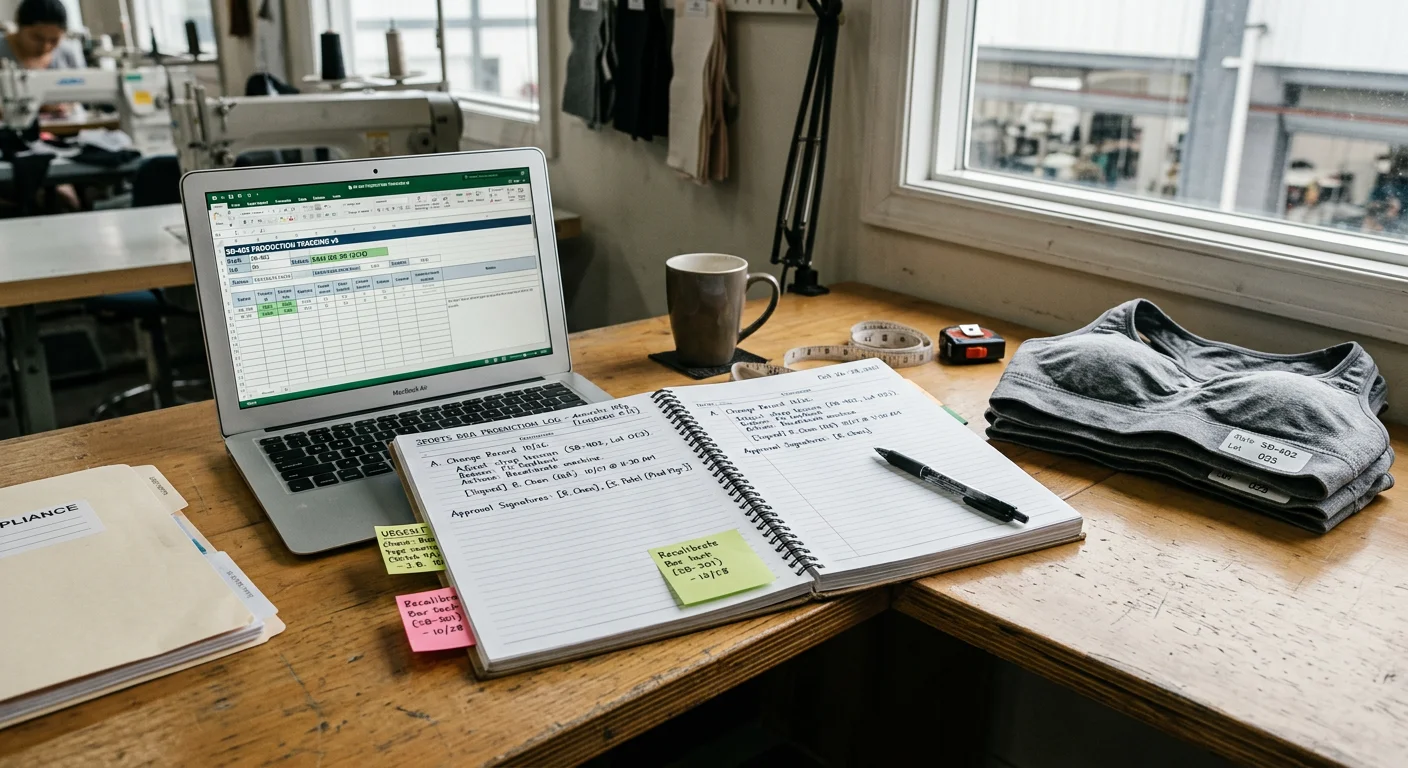
Log every change with full detail: what changed, why, who approved, effective date, and which POs it applies to. That log is your institutional memory — and your defense if a compliance question ever comes up.
Conclusion
Domestic manufacturing isn't the easier path — it's the smarter one for brands that intend to last.
You now have the regional cluster map, the real cost numbers, the 14-dimension evaluation framework, and an 18-week roadmap. It takes you from cold inquiry to your first bulk delivery. The information gap that made made in USA custom sports bra production feel unclear and out of reach? You've closed it.
Here's the move: don't let this guide become a bookmark you revisit someday. Pull your top three factory candidates from the evaluation framework. Send your tech pack this week. Treat the sampling stage as your real audition process — not a box to check.
The brands winning in American-made activewear right now don't have the biggest budgets. They started the activewear supplier conversation ninety days before they needed to.
Your supply chain is a brand decision. Make it a clear, intentional one.